
Fixation of Attention and the Power of the Gaze
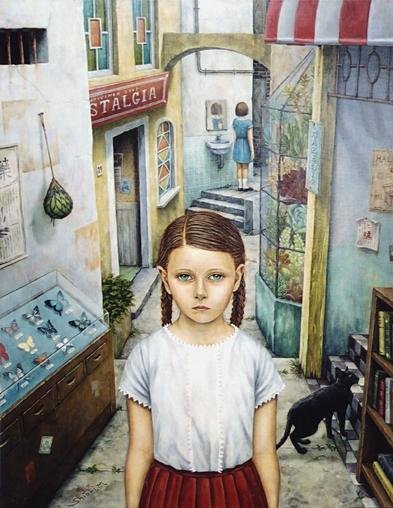
One of the most popular topics in folk-magical discussions is the “evil eye”, the “malevolent glance” and similar subjects concerning a person’s influence on the surrounding world through their gaze.
However, beyond the grandmothers on the bench in front of the house, this question is useful to discuss with those who are beginning the path of Magic. Not because Magi necessarily gaze indiscriminately, but precisely because, in order not to introduce an unexpected element into one’s magical operations, one must know exactly what effect a person’s gaze has.
It is precisely the heightened interest of overly excitable women in the “evil eye” that makes this topic awkward to discuss in serious circles. And yet it must be taken into account.
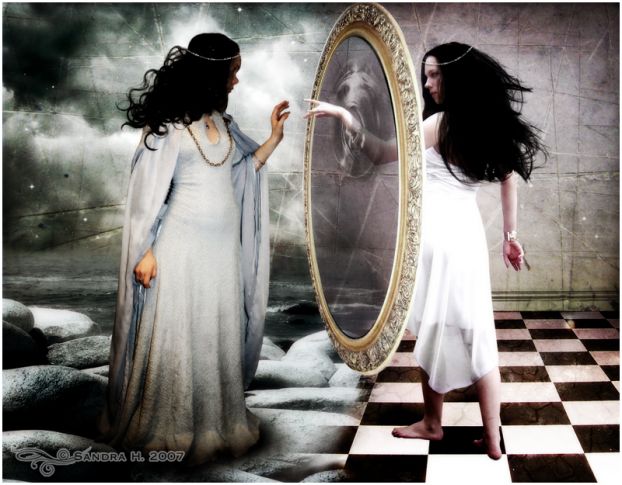
It is well known that the human eye is capable of projecting information onto the physical world, producing images, phantoms and actual manifestations. We won’t dwell on pseudo-scientific explanations of this fact, but will discuss its traditional meaning. We will also not linger on equating the physical eye with its symbolic or eidetic content — we will speak of the eye not as an organ, but as the point of contact between the Macrokosmos and the Psychocosmos.
Corresponding to the spheres of Mind and Wisdom, the eyes are the element connecting the external world with the internal structures of the Psychocosmos. In other words, the world of objects in the Psychocosmos is born only after these two elements (Mind and Wisdom, Chokmah and Binah) single out from the totality of external energies those that can be used (“perceive“) to form a coherent picture of the world.
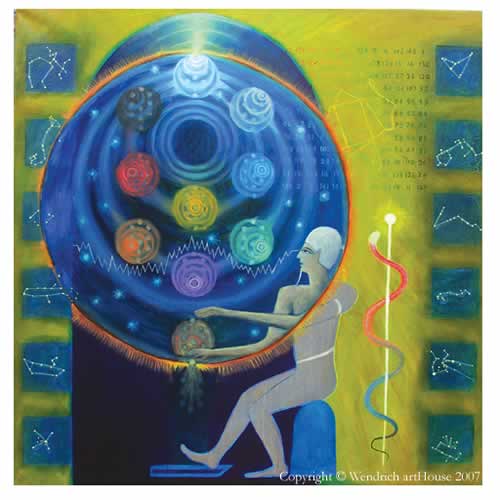
The element of activity (Chokmah) chooses those energies, while the element of passivity (Binah) creates the medium for their interaction. Chokmah is active; Binah is stable by its nature; Chokmah is merely a stream of unregulated energy. Thanks to the stability of form, Binah rigidly subordinates the eternal striving of Chokmah and ensures its limitation.
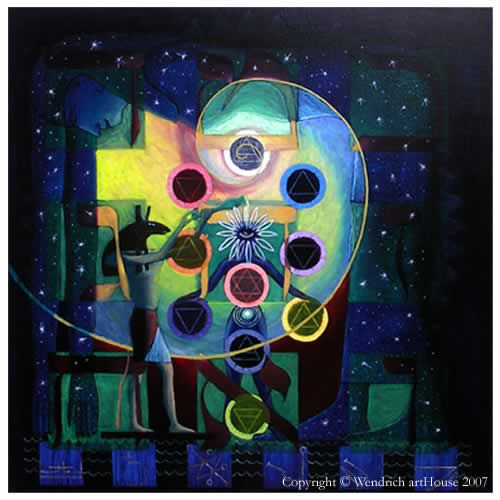
But what does the “evil eye” have to do? Exactly that. The activity of perception not only directs the imprint of external energies into the psychocosmos, it also establishes a link between the energies “outside” and “inside” the person’s makeup. In other words, it creates an apparent identity between the external (unprocessed by awareness) and the internal (perceived as the image of an object or phenomenon) energy components. And in the process of this creation, not only is an image formed within the composition, but characteristics of that image are also “imposed” on the external energies.

A simple example: one person observes another at work. In doing so, the observer not only perceives the process, they also “impose” their perception of that process on the worker. And it is far from certain that this perception corresponds to the worker’s own understanding. When there is a mismatch, a conflict of wills arises, and the worker’s task begins to falter — after all, it is effectively being performed by two people: the worker and the observer, whose skills and abilities may differ significantly.
The mechanisms of this interaction can vary — most often vortex-like structures form, “larvae” that mediate the influence. There are other variants as well, but that does not change the essence of the matter.
Thus it turns out that observation, perception, is an intervention into the existence of “external” objects, to which the qualities of the “internal” elements of the conscious picture of the world are actively imposed.
Obviously, this process is usually involuntary, occurring at the pre-volitional, “automatic” level of the basic structures of awareness.
It is known that those prone to giving the “evil eye” are usually not malicious people, but those who have significant unrealized potential. Most often this happens when a person “disciplines” himself in an incorrect way, merely suppressing the unacceptable manifestations of his nature from his point of view. For example, a woman who tries very hard to be “good”, helps her relatives and loved ones and suppresses outbursts of irritation caused by some of their actions will likely have a somewhat “malevolent” gaze.
Often such an imbalance may also be the product of child-rearing, when a child is likewise forced to repress their impulses deeply.
It is clear that for a Magus it is absolutely necessary to carefully control one’s influence on the surrounding world, including imposing one’s view of it.
In order for such influence to prevent distortions into the Magus’s operations, it is necessary to balance this active component with the passive.
To eliminate the imbalance it is necessary not only to find balance between manifestations and causes (this is a separate discussion about how one should train oneself), but also to attempt to find the threshold between what we expect to see in an object or phenomenon and how that object or phenomenon itself wishes to present itself to us. Chokmah — “the action of an unquestioning force” — must be balanced by Binah — “the questioning aimed at understanding”.
Very interesting. This is true not only about looking at the object of attention but also about listening and thinking about it. “…it is absolutely necessary to carefully control your impact on the surrounding world, including imposing your view of it on this world.” This means that there is an active attention component in us that finds objects for research, to build our worldview. Why is this a “non-questioning force action”? The picture: one jinn from Hokma chooses an object, points out what to focus attention on. And the other – Bina – creates an imprint, draws this object. And the quality of this drawing depends on both the artist’s skill and the choice of drawing tools. Then this created image, like the portrait of Dorian Gray, lives its own life and can influence the object. Or like this, the artist’s eye stopped on the girl Lisa, saw the heavenly miracle in her, painted Mona Lisa, the girl looks at her portrait and discovers the miracle within herself, she changes. To prevent this picture from being distorted, “in order to balance this active component with the passive, such an influence should not introduce distortions into the mage’s realization.” “To eliminate the imbalance, it is necessary not only to establish a balance between manifestations and their driving forces (this is a separate discussion about how one should and should not educate oneself), but also to try to find the boundary between what we want to see in an object or phenomenon and what that object or phenomenon wants to show us.”
What about what the object of attention actually is? After all, many of us claim that we see the object itself, rather than what we want to see or what the object wants to appear as 😉
This is relevant for those “watching” who “read others’ thoughts” or confuse theirs with others.
There is also the concept in witchcraft of self-evil eye, when people harm themselves through reflection, as well as confuse themselves with words and thoughts. A wide spectrum of protection is offered – from superstitions, conspiracies, to energy shields and mental programming. But this does not eliminate the root of the problem, the eel-harmful that grows from the dark areas of psychocosmos. For sorcerers, just like for psychics, the issue of purity of consciousness basically does not arise. It turns out we can not only perceive the work of a person distorted”… And it is by no means a fact that this perception corresponds to the worker’s own representations. In the case of discrepancy, a conflict of wills arises, and the worker begins to have “things falling out of their hands”….”, but also the personality and image of a person, hanging labels on them, their images, conclusions, and perceptions. The problem is that these data distortions arise from shadows, predators as I understand, and they themselves are against control and awareness. If we take society, then everyone “looks” at others, “looks” at themselves, “looks” at the universe, interacting not with the person themselves while still not being themselves, the world of the deaf-blind-mute. I’m like that too. The previous topic with the post about my changing reflections is confirmation of that. It’s interesting to think about what the perfect reflection of a person is, when their soul is transparent (not reflecting) or looks shining?) But most often, looking deeply into the reflection and ripping off all masks, people fear to see the terrible monster, most often they see it…. but it is not the soul.
Hello! Where does this construction come from when people say, for example: “What a smart boy! No, silly, curse you so as not to jinx him”? If we start from the article’s perspective, when such a statement arises in the speaker’s consciousness, the smart boy (that is, the person really sees and interprets the boy as smart), then the boy should seem to become smart. But the speaker immediately complicates everything by adding “silly,” precisely to avoid, in the speaker’s opinion, jinxing him.