
Fidelity of the Magus

Alongside honor, another somewhat forgotten key concept on the Way of Magic is the notion of fidelity.
For the Magus, fidelity is, above all, an awareness of responsibility and a strong sense of self.
In other words, a Magus cannot sever certain bonds that have formed on his Way simply by walking away from them. It turns out that these bonds are woven into the very fabric of the Way, and to break them is to betray the Way — and therefore to betray oneself.
Modern public opinion “smooths over” the importance of fidelity and the danger of betrayal. The reason is obvious — the more often one betrays oneself, the less stable one’s Way becomes, and the easier prey one becomes.
The very word “fidelity”, in one sense, implies “rightness”, conformity, in general, to “truth”; for the Magus — to his Way.
Since there are no trifles on the Way of Magic, fidelity to the Way, fidelity to oneself, is impossible without fidelity to one’s word, to accepted obligations, and to loved ones — not only when circumstances favor it but also when the whole world seems to incline toward betrayal. Any betrayal, however insignificant it may seem, is a step into darkness, a step away from oneself and one’s Way.
Betrayal is when one thing is put in place of another. In other words, it is the usurpation of position, a substitution — which means a lie, a Qliphothic action. For example, when a mistress replaces a wife, or when one ideal is substituted for another.
For a warrior, military deceit toward an enemy may be permissible — that is not betrayal. But he must not deceive someone who trusted him. That is utterly unthinkable, for it turns him into a devourer — Qliphoth.
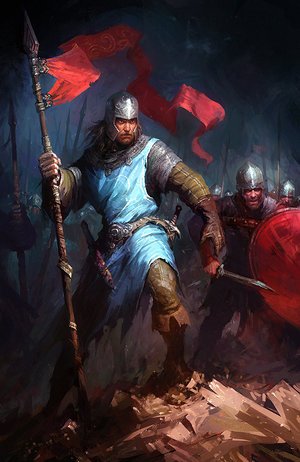
As is well known, a medieval knight was required to keep unconditional fidelity to his obligations toward his peers. The custom of taking unusual knightly vows, vows that had to be fulfilled despite common sense, is well known — akin to the Irish geasa — they mark boundaries on the Way and allow one to preserve one’s sense of self.
Using an enemy’s weakness did not bring a knight glory, and killing an unarmed foe covered the killer with shame. Lancelot, a knight without fear or reproach, could not forgive himself for the time when he had killed two unarmed knights and only realized it when it was too late; he made a pilgrimage on foot in a single homespun shirt to atone for that sin. Nor was it permitted to strike from behind.
It is evident that such artificial boundaries are not always appropriate for the Magus, but the idea of fidelity lies precisely in maintaining the separateness of one’s Way from a world of universal betrayal and predation.
But of course this is not without its destroyers here as well. People have been taught to be “faithful” to a thousand arbitrary injunctions that hold their world together. By “fidelity” they usually mean stubborn clinging to everything imposed by family and society — and therefore dependence and lack of willpower.
For the Magus, however, fidelity is, above all, loyalty to oneself, enabling him to struggle against the lies that surround him on all sides.

Please tell me, if you commit such betrayal, can everything be returned by putting the object back in its rightful place, or are there things that, once destroyed, cannot be restored?
It’s difficult to answer in general. Sometimes it can be restored, but sometimes the destruction is irreversible.
Due to infidelity, you make the heaviest mistakes in life. Everything is perceived as mere carelessness, misunderstanding, but in reality, honesty with oneself has long been lost, or it was never there. It usually ends with the loss of the Path, a serious trauma, physical or emotional, or even worse, the pain of a loved one, which they may never forgive. Then you are left to regret it for the rest of your life. And if you still manage to return to the Path, restore what can still be restored, and for the future, learn loyalty, devotion, responsibility, and honesty with yourself in advance. This is very important.
Of course, it’s important. But a person is a Process. Therefore, their self-identity is not fixed, and loyalty to their self-identity, realized at one stage or another of themselves as a Process, sometimes hinders the flow of life itself. There is a fine line between Loyalty and Holding, which leads to vampiric plots (various egregorial, social, ideological dependencies, etc.).
Within the framework of the described Myth, being is not only a process but also a substance, although the line mentioned by you is indeed fine – just like all lines in the world of Magic.
Both substance and person are stages of the Process. In turn, their own processes occur within them. The substance undergoes alchemical transformation, while the person evolves-involutes (as a species and as an individual material form of consciousness), etc. The scale of containing individual human consciousness (at its stage of the process, in one myth or another) in understanding itself as a total Process affects its understanding of Loyalty and Loyalty to the Process. A new Stage is always an apocalypse for the old one, but outside of linearity, they are already not opposed, as there is no ‘new’ and ‘old’, thus there is no treachery and loyalty in the meanings characteristic of linear consciousness (‘stages of the Process’), nor the necessity to remain loyal to a particular myth – each one is a world and structures space with themselves, for themselves. That is, myth for the Creator as Process is merely a means and a way to manifest the Self, He determines the rules, while for creation as an element or stage of the Process, myth is the medium of existence and then the rules are imperative for being within it.
After the Circle of Veles, I met a Great person to whom I became very attached and loved; he turned out to be a devourer of klippot in my world. I created a world for him in his world where he can now act for me as a human.
After the Circle of Veles, after 3-4 years, I managed to describe, correct the myth of my devourer of klippot. To discover and interact with the awareness parasite.
Hello. I have committed a betrayal of myself, and now I can’t find my way back to the path I was on before. I don’t see any new path for myself anymore. Can you tell me if the changes after betraying oneself are irreversible, or is it possible to at least partially return to the previous state? Thank you in advance.