Breadth of Vision
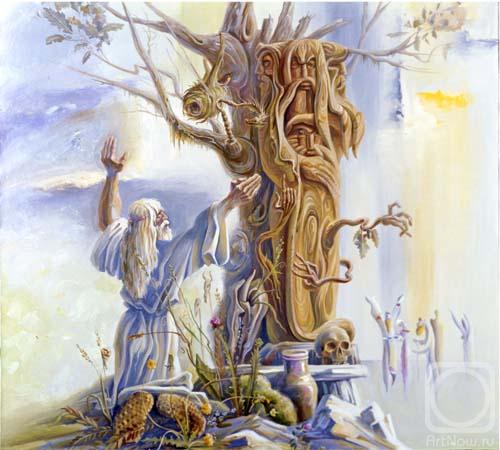
Among contemporary traditional pagans, as among neo-pagans, there is, unfortunately, often a haughty intolerance toward Christianity and other monotheistic religions; conversely, Christianity’s attitude toward pagans is even more hostile.
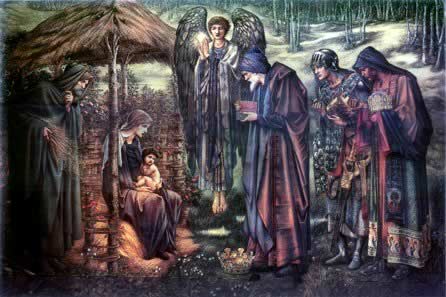
And while such an approach from Christianity is quite logical — since that religion, claiming global dominance, naturally claims primacy of truth — there are no ideological obstacles among pagans to being receptive. After all, the presence of living Gods does not in any way deny the existence of the Almighty. In the end, it was precisely the pagan Magi who first went to greet the newborn Christ, yet they did not become Christians.
It is the pagan outlook on the world — on its material aspect and spiritual inner life — that ought to serve as a model of breadth of awareness and tolerance.
Of course, this outlook cannot help but bear the imprint of a distinctly pagan, polytheistic–pantheistic description of how things work, but that imprint should not narrow one’s vision.
In fact, although the pagan is primarily oriented to calling on the Gods, he is by no means obliged, for example, to ignore the presence of lesser spirits and their influence on the world.
However, as we have already discussed, eclectic views do not necessarily imply their synthesis. A well-known, poorly executed attempt to synthesize druidic beliefs with Judeo-Christian magic was made by the founders of the movement “Wicca“. Wicca became known in 1954 thanks to D. Gardner, who claimed that the tradition into which he had been initiated was a surviving form of ancient witchcraft, and it has gained popularity ever since. Unfortunately, the Wiccan tradition often attracts attention chiefly for its particular emphasis on the sexual aspects of power, which frequently trivializes the spirit of paganism itself. What has been said, of course, in no way diminishes the strength of those for whom the Wiccan Way is a Way of the heart, a source of inspiration and revelation.
Therefore the pagan Magus who wishes to be successful in his Way often does not synthesize, does not merge different ideas, but approaches them from his own viewpoint, adapts and applies them.
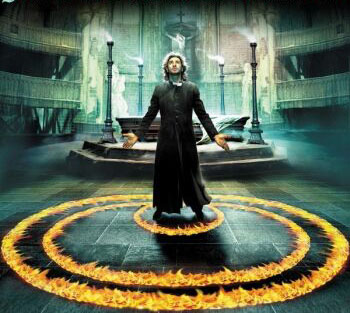
From the standpoint of religion, it is impossible to be both an Orthodox Christian and to perform the Muslim prayer. But from the standpoint of magic, it is entirely possible to apply ideas and approaches drawn from different — even unrelated — sources, provided that these ideas harmoniously coexist within the personality of the Magus himself. For the Magus himself is the central figure of the system under consideration; it is his views, his experience, his power that determine the world he lives in, the laws that operate there, and its inhabitants.
Regarding the “convenient combination” of different religions, one can learn a lot from the Japanese, who, for the most part, “apply” religion rather than turning to it… and in defense of neo-paganism, it should be said that their faith is more based on the denial of monotheistic religion than on the breadth of views. After all, for a long time, monotheism imposed its own rules of the game, applied overwhelming force, and now the modern movement back to “roots” is an inertial force of a compressed spring acting in the reverse direction.
Good article! If we talk about tradition or syncretism, there can be a lot of debates here, very old and well-known. I am a proponent of only my own Experience, and I advise others to do the same. And I have several questions for those who adhere to tradition: Where does this ‘our’ tradition come from, considering that the Soviet Union recently ended? Are we making it up? Are we weaving whole mountains of stories from two scribbles? Do we adjust it, as always, to reality? Why not take reality straight away and start from there like normal magicians have always done? Something makes me doubt that anyone is really familiar with the true ‘pagan’ (let’s call them ‘the traditions of our ancestors’) tradition. Whoever it may be, I will say: look around; the real tradition comes from where a person is. And what do we see around us? Cities, cars, computers, and a bunch of abstract people. Instead of working on their development, people start to fuss around like bums in the past and put on bast shoes and white shirts! One must know that humanity’s experience cannot be dismissed, but we must focus on what is present now. And create magic here.
Ah, but the Discreteness of thinking is indeed an unpleasant thing! Therefore, I join the author in saying, ‘Look broader!’ and don’t forget about the Earth beneath your feet!
There are different laws 🙂 There are those that are written in long lists and proposed by certain authorities with smart faces to the general public for memorization. There are those that act, yes, but they act only because some groups of people long ago came to an agreement (whether by their own will or fulfilling someone else’s – it is unknown) that certain assertions are laws and inscribes them in the consciousness of newly arrived people. And everyone together fervently believes in “laws” – but from time to time events occur that do not fit into their “code of laws” – on this, everyone cheerfully closes their eyes and pretends that nothing happened. And they collectively support the “inviolability of laws” and the stability of their own view of the world at the same time. There are also True Laws. Some of them, if they were ever recorded, are not recognized as universal laws. But it is impossible to resist their action. For example, the Law of Equilibrium. These Laws are collected by an inquisitive mind bit by bit, through personal experience.
In my opinion – to sit down and come up with a law is impossible. All laws reflect the structuring of the world from which they stem. Quite often this is a description of one aspect of a being or a description and structuring of some system. I cannot call them untrue and invented – they describe and structure what exists. They reflect the personal opinion of the author and the content of his head or some system. What you are talking about is also an understandable thing, the forgotten Platonic method of cognition from the whole to the particular, which allows a person to discover laws common for all systems in which they exist. This is the property of all Egyptian and other more or less intact sources – from another point of reference, from whole to particular. The peculiarity of awareness is that reading them is useless and sometimes harmful – they need to be discovered by oneself.
And before becoming acquainted with local structuring about beings, I used to call such laws round. Each such found whole law – in my opinion – is remarkably beautiful.
There are not so many authors known to me who can embrace the whole world in their gaze, one of them, the marvelous physicist Roger Penrose, once said well about this:
“Can beauty be a criterion for accuracy? – Oh yes! It is very difficult to formalize this. People assess differently what is beautiful and what is not. When simplicity arises, it is very difficult to explain why it is beautiful. For many, it is unconvincing. When discussing the laws of nature, I say that they are somehow unconvincingly beautiful. But if you ask why they are like this, I do not know…”