
Animals and Power
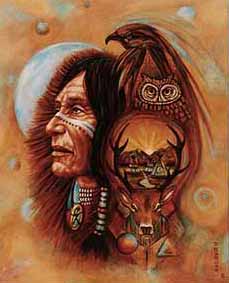
All ancient cultures of the world, in the fragments of knowledge that have reached us, speak of astonishing beings that come to people’s aid and often save their lives. Animal Powers were regarded as immensely useful to people, who greatly need that direct, unmediated, absolute connection with the universal life force that animals possess.
Traditional mythologies describe three forms of interaction with the powers embodied by wondrous animals: 1) the totemic animal (the animal connected to the nature of a particular person, group, or clan. The totem expresses the powers inherent in the person); 2) the animal of power (an animal that expresses a power the person must take on, a power without which they cannot fulfill their destiny but which they lack); 3) the animal whose form a person assumes (shape-shifting) — a part of the human unconscious that seeks to engulf the person’s mind.
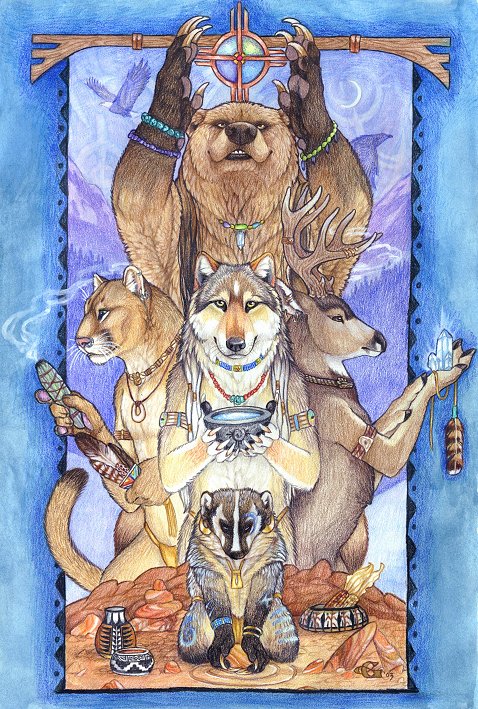
1. Totemic animals.
Among the ancient Scandinavians the idea of a totemic animal took shape in the notion of the “fetch“. An older form of the term “fetch” is “fylgja”, “filgi” (Icel. fylgja), literally “companion”.
Fylgja — a being which takes a human form (this is a simplification) and which in turn is a kind of projection of the person into the spirit world (essentially a representative or double). It is an external guiding spirit that leads the person, and it is also a spirit-double, an independent reflection with its own will. A fylgja-companion could belong not only to a Magus; shortly before death it would leave the person, and other people, especially those close to the dying, might see it. Often the fylgja appeared as a magical animal. It is believed that every animal is endowed with a spirit. This spirit may be either the spirit of the animal itself or another spiritual being that uses the animal’s form to communicate with the human world.
It is well known that many Scandinavian gods have their totemic animals. Thus, cats were associated with Freyja, Odin with the wolf or the raven, as well as with the crane and the snake, Freyr with the horse, the boar and the stag, and so on.
As the progenitor of a group of people or animals, a totem may be linked to a person from birth. One does not need to be a Magus or a shaman to possess such a totem. Much more significant for a shaman are his personal totems. These are acquired in a difficult struggle in which the shaman must defeat either the totem itself or the spirit that has bound it (for this he must descend into the lower world). After this the shaman and the totemic spirit are bound by close mutual ties that extend into the afterlife — the shaman joins the group of totemic beings of his kin in the lower world.
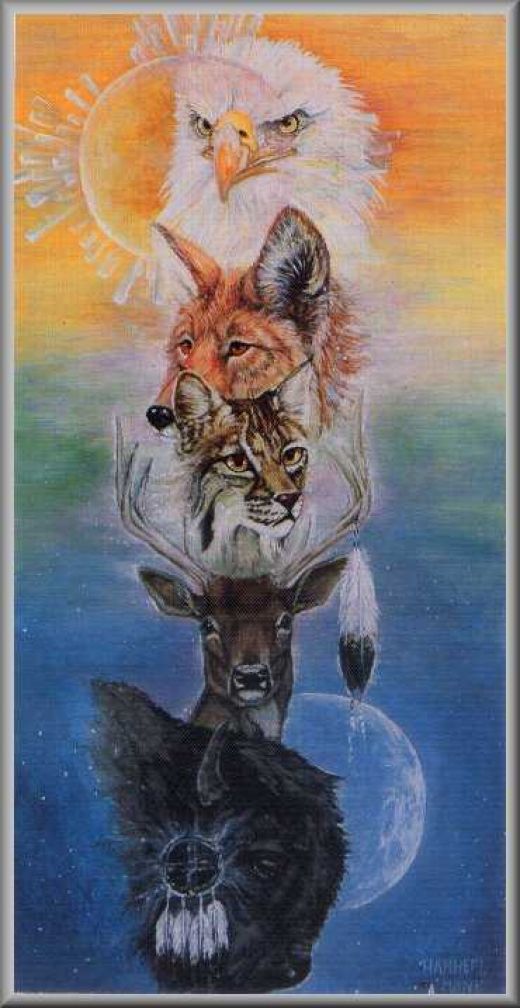
2. Animal Powers.
It is believed that all people have animal powers whether or not they are aware of them. One can even lose or have an animal power taken away because of illness, emotional trauma, mental exhaustion, or other reasons. It can be taken unconsciously or deliberately by another person.
The return of a lost animal power is one form of healing that restores a person’s wholeness.
Animals that accompany a person on the hunt help mirror aspects of their own nature — instinctive and intuitive powers distinct from intelligence, will, and reason. The animal of power serves as a means of communicating with certain aspects of a person’s mortal nature, as opposed to the immortal nature of the higher “self”. It represents a potential, talent, ability, or characteristic quality inherent in the personality. The traditional aim of becoming acquainted with an animal of power is to understand its attributes, which must be developed within oneself.
Possessing an animal power does not yet mean that its attributes are being used; they are merely present, awaiting their expression and development.
When a person identifies their animal power, the qualities of that animal begin to affect their being. This is life power in the form of an archetype, which can find expression in terms of human awareness.
The primary quality of an animal of power corresponds to the characteristics of the animal whose form it takes. These properties and attributes belong not so much to a particular animal as to the ideal “group soul” of that animal species, whose “echo” is contained within the human being since it is an aspect of their own animal nature. For example, the chief attribute of the lion is strength, of the eagle — keen sight, of the fox — cunning, of the beaver — industriousness, of the turtle — persistence, of the snake — transformation, and so on.
However, while such generalizations can be useful, the animal of power usually reveals to the person its main quality.
Traditionally, the aid of an animal of power has been a time-tested method for gaining knowledge and personal power used in religions, psychologies, and philosophies. In tribal cultures the animal often appeared during the Vision Quest — the initiation rite of young people into the spiritual traditions of the tribe.
Sometimes notions of animal powers took an entirely literal form. For example, in West African countries there is a rite in which sorcerers take blood from the ear of an animal and from their own hand and graft their blood onto the animal, and the beast’s blood onto themselves. It was believed that from that moment a bond arises between them so close that the death of one entails the death of the other.
Opinions differ regarding the permanence of Animal Powers: sometimes it is thought that an animal of power becomes one of a person’s Keepers and remains with him for the rest of his life. Others hold that each animal of power stays with a person for several years, then is replaced by another. Animal powers that remain a person’s totems for life are, as a rule, wild rather than domesticated animals. It is believed that there are two kinds of animal power-totems: the internal (central) (the one that defines the person’s essence) and the external (spirits that help the person and guide him through life). The internal totem is the animal whose habits, customs, and way of life suit you best. Someone compares himself to a wolf, or a jaguar, a bear, or a mouse. The external totem guides the person through life like a guardian angel and manifests itself in different ways, depending on the traditions the person follows.
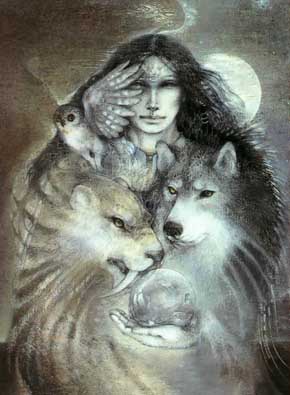
3. Shape-shifting
However, animal nature can sometimes not only assist but also overwhelm human nature. In many countries there was a widespread belief in people who could assume an animal form. The Scandinavian myth contains many references to transformations into animals — for example, Odin, in his quest for the mead of poetry, turns into an eagle and a serpent; the giant Thjazi turns into an eagle to steal Idunn’s apples, and Loki, in pursuit of him, takes the ‘falcon necklace’ from Frigg, and then transforms sometimes into a flea, sometimes into a fish.
As a rule, popular belief associates them with the most dangerous animal in the region. In ancient Europe, from Russia to the Atlantic and from Scandinavia to the Mediterranean, the animal was the wolf. And as early as 125 BCE the Roman poet Marcellus Sidst wrote about lycanthropy, noting that the afflicted person is seized by a mania accompanied by a terrible appetite and wolfish ferocity. According to Sidst, people are more susceptible to it at the beginning of the year, especially in February, when the malady is most widespread and can be observed in its sharpest forms. One legend says that in Arcadia people transformed themselves into wolves in the course of a special initiation ceremony. Those wishing to become wolves were taken to remote marshes. There they stripped off their clothes and waded through the mire to a special island. On that island the newcomers were received by the same wolf-people and lived among them as equals.
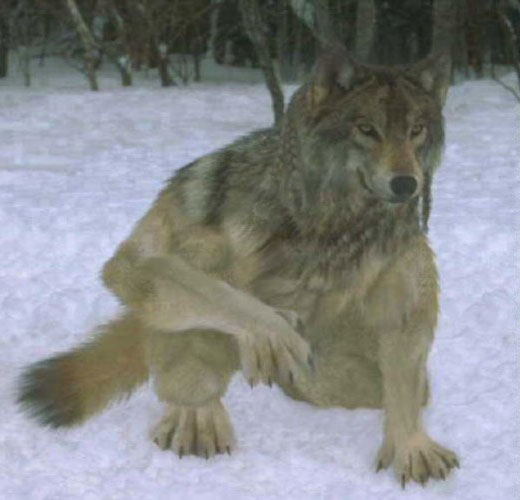
Thus, the “temporary” shape-shifting of gods, Magi and shamans is transformed into “permanent” and even compulsory shape-shifting.
If a wild animal strangely approached a person, can this be seen as a manifestation of animal power or some indication of where to search for it?
If this happened during an explicit or implicit search for animal Power, then – of course, it can be. But if it occurred in a ‘normal’ situation – then not necessarily, it may just be an animal that trusts you 🙂
This happened during the search for a ‘place of power’. But maybe it was just a very curious animal 🙂
🙂 during the Search, ‘nothing’ simply happens
Once in the group, there was a task to meet your guardian angel. One woman later told that she met a deer. Everyone was very surprised. If in childhood one wanted to draw a howling wolf under the moon – is it a totem?
Perhaps quadrants are echoes of lycanthropic rituals, an attempt to find one’s animal guardian and intermediary.
Unlikely, this is rather just a strange form of teenage rebellion.
Thank you very much