
Endless Possibilities
Day is God’s messenger,
beloved by people,
the ruler’s light;
hope and joy
to rich and poor alike
and to the benefit of all.
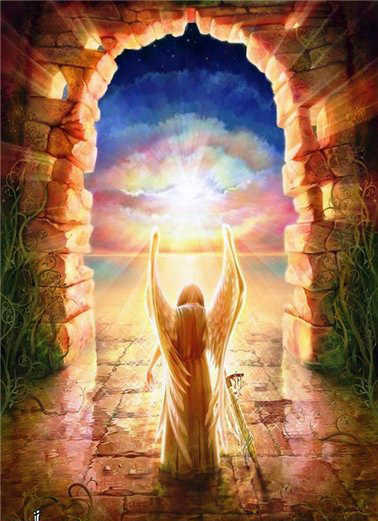
The Third turn of the World Wheel is concluded by the transcendence, which elevates existence to a new level, barely discernible from the present perspective. Note that, unlike the gradual unfolding of the Cycle into Three stages, the exit beyond its bounds is always achieved by a leap, and the element of spontaneity is essential to that leap.
Indeed, there is no way to make this transition planned or inevitable. One may prepare for it, one may expect it, but it always occurs suddenly, and its success depends on the state of readiness.
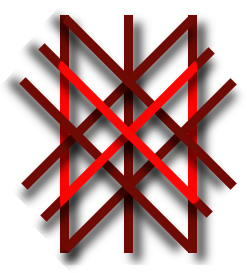
The Rune Dagaz (Day, Daeg) symbolizes the moment of awakening, a fundamental turning point, a critical instant that can forever alter the course of events.
Mythologically this Rune corresponds to the Ásynja Iðunn, Keeper of the apples that preserve the gods’ youth and strength.
Clearly, the powers of Dagaz correspond to the formation of a bridge, of gates, whose crossing opens new opportunities. In other words, this Rune requires active effort aimed at seizing the opportunity.
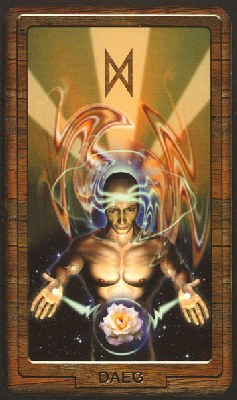
Dagaz’s liminal position allows ascribing to the rune the forces of union, universal unity, achieved by uniting opposites. The rune’s graphic form of the Twenty-fourth Rune marks this aspect: the essential identity of Morning and Evening twilights, the exit beyond the Cosmos and, at the same time, the passage into its Center.
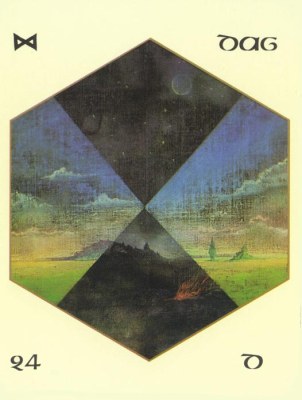
Another concept related to Dagaz’s field is intention as the formed framework of being, and the plan that becomes the driving force of realization. In other words, Dagaz describes the transition of being from one phase to another, from perception to articulation, from idea to action.
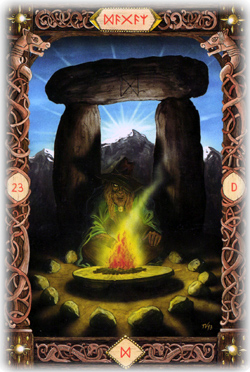
Graphically, Dagaz can be regarded as a Gebo bounded by Isa, which indicates the liminal character of this Rune and the unexpectedness of the Breakthrough, and also as a “bloomed,” opened Othala, likewise noting the opening of gates.
Magical applications of this Rune include securing a favorable outcome in affairs, as well as healing, especially of chronic illnesses.
Sigrdrifa apparently assigned Dagaz to the “Runes of Thought”, indicating the direction of the rune’s forces flowing outward from within, and according to the Head of Mimir this Rune adorned “Arvak’s ears,” marking the enlightening character of this revelation.
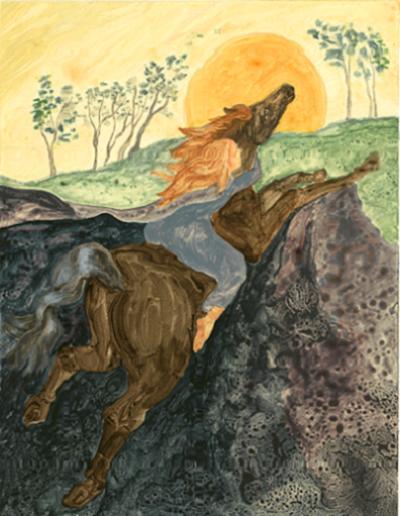
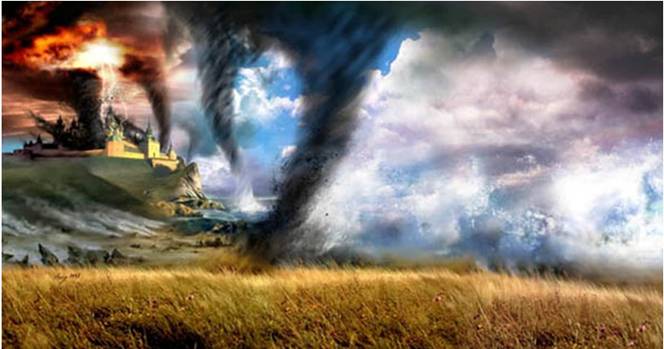
At the same time, clumsy use of this rune promotes an overly early, unprepared Transition, which can lead to disembodiment and the loss of one’s evolutionary standing. In this respect Dagaz corresponds to the illusion that befell the gods (Thor, Loki and their companions) in Utgard.
If you feel the need to use the rune Daggalaz, and before that there was successful work with the rune Inguz, is it really possible to “summon” Daggalaz by oneself? Or does it “come” only by itself when it deems necessary?
“Dagaz as a symbol of infinity in its original form. Is it possible to consider this symbol in its inverted form? From the combination of the inverted and direct Dagaz, I got this symbol: http://ru.wikipedia.org/wiki/Орден_Святого_Георгия.”
After reading your description of “FUTHARK”, many things fell into place within me. Enmerkar, you turned chaos into a clear “multiplication table” all in its proper place. Once I read that the layout of the Runes doesn’t matter, you showed me the opposite. Thank you.
Hello, Enmerkar!
Can you tell me why you use an image of a different matrix in the description of the last three runes?
I am very grateful to you.
An association arises with a black hole, like a gate from the last cyclical cycle of civilization, according to one theory, to a new reality. Monroe had something similar with the family leaving for the stars. And the focal point, the point of transition, where everything and everyone is close and one whole and the binder is compressed into a point.