
Application of Knowledge
«As – lord of speech,
seat of wisdom,
consolation to the wise.»
The force conceived in Fehu and Uruz and borne by Thurisaz finds its manifestation in Ansuz. In other words, Ansuz (As, the mouth, the orifice) corresponds to the very process of the birth of force — neutrality — fertile passivity.
The fourth Rune of the Elder Futhark is connected with what so many contemporary rune practitioners lack — inspiration.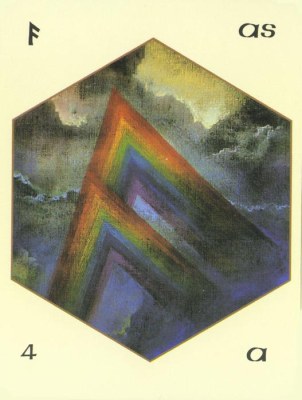
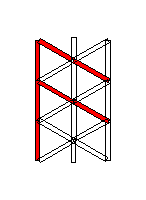
This is the Rune of creative thought embodied in the word, for the word is the body of thought.
Mythologically, this Rune is associated with the Aesir, especially Odin (its image is Odin’s blue cloak billowing between worlds), and with the process of Creative Transformation of the world that they carry out.
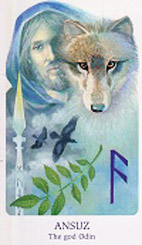
At the same time, Ansuz is also the flip side of applying knowledge — that is, perception and understanding.
Speech, which on the one hand embodies a person’s inner life (“inner dialogue”) and on the other is how a person manifests outwardly, also belongs to the semantic field of the Rune Ansuz.
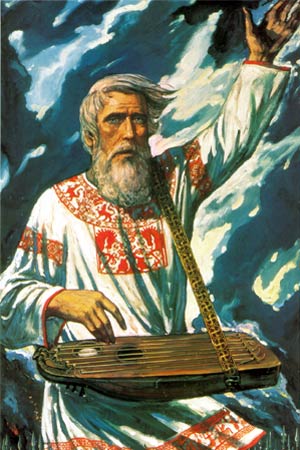
The creative word is perceived as a magical manifestation, an incantation, regardless of how close it may be to a command. When a teacher tells a pupil, «Stand up and leave the classroom», and the pupil obeys, we are dealing with an incantation — verbal authority.
Thus speech, the mouth, words — all of these are embodiments of the force symbolized by the fourth Rune.
The power of the word is always a deeply personal power. What a person says and how they say it best expresses their personality. Probably for this reason the Erili traditionally stained Ansuz (unlike the other Runes) only with their own blood.
The magical use of the Rune Ansuz includes not only attracting inspiration and speech but also facilitating perception and understanding.
From the viewpoint of mythical objects, Ansuz is of course identified with the cauldron Odrerir and with the mead of inspiration contained within it. From a practical standpoint, mead contains Aesir and Vanir wisdom (since Kvasir, whose blood became the mead, was formed by mingling Aesir and Vanir powers as a sign of peace between them), embodies analytical knowledge and intuitive wisdom (both “the knowledge of the head” and “the knowledge of the heart”).
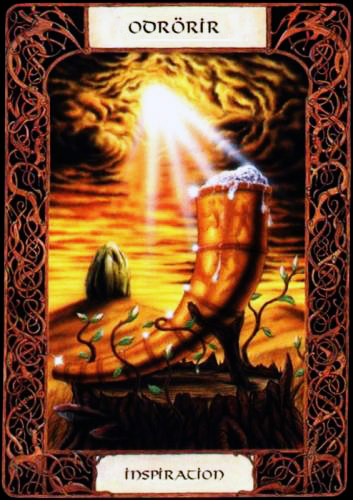
Second, the mead once belonged to the Jotuns and passed to the Aesir after Odin’s theft. In practice, this means that the reception, transformation, and expression of knowledge requires the application of strength; “a man understands signs when he is strong.” Furthermore, wisdom inherited from ancestors does not pertain to the superficial qualities of personality; its source lies in primordial depths.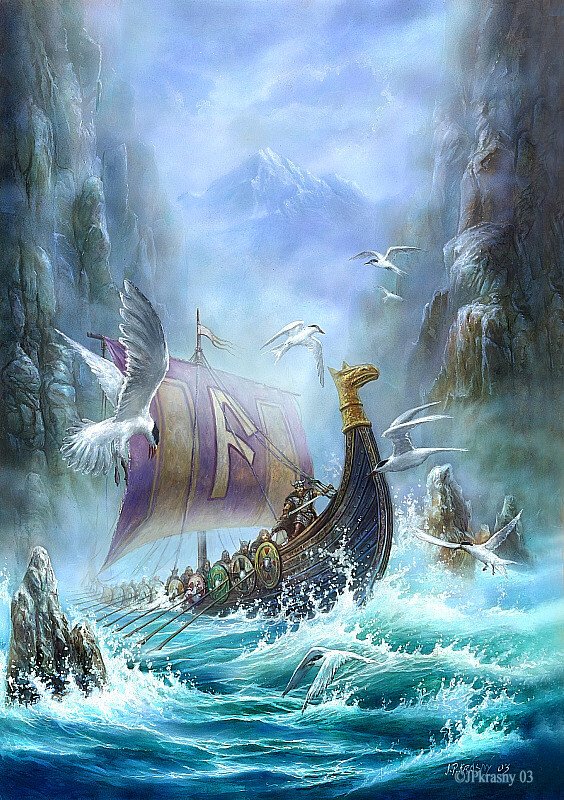
From the perspective of rune transitions, it is interesting that Ansuz can emerge from Uruz, and the Aesir descend from the Jotuns; i.e., knowledge follows from wisdom.
Unskillful use of Ansuz is linked to Odin’s shadow aspect, Loki.
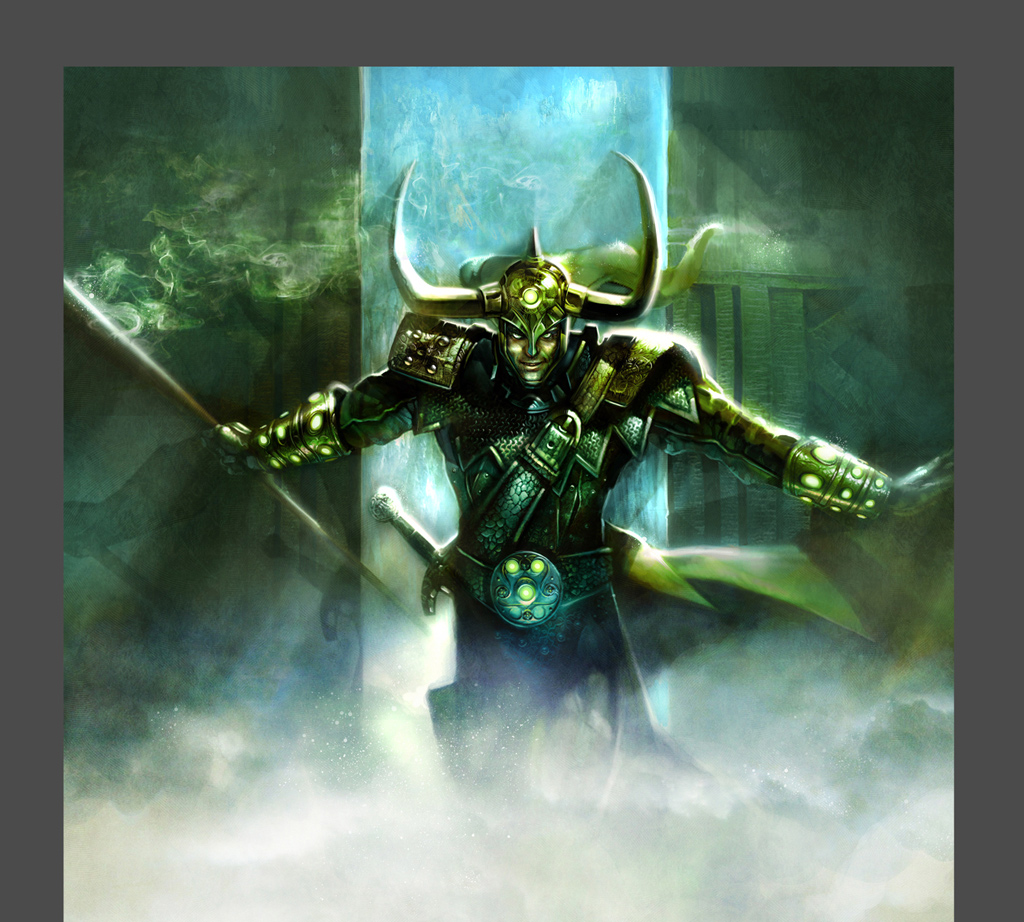
Loki likewise is not lacking in inspiration; however, his inspiration, although necessary for the cosmos as a whole, can be traumatic for its individual parts.
In this aspect, Ansuz is a rune of lies (even if sometimes “for salvation”), of contempt for one’s neighbors in the name of ‘higher aims’, betrayal, and guile.
Aunsuz is not only the embodiment of thought through words, but also through any creative expression of oneself outwardly, right?