
What Did Mimir’s Head Tell Odin?
“Mimir’s children began the game,
the end proclaimed
by the horn Gjálarhorn;
Heimdall blows; he has raised his horn,
Odin converses with Mimir’s skull.
Yggdrasil trembles,
the lofty ash,
the ancient trunk thunders,
the thurse bursts forth.”
(“The Prophecy of the Völva”)…
“The ash Yggdrasil trembles, and all beings in heaven and on earth are filled with terror. The Aesir and all the einherjar arm themselves and march onto the battlefield. Odin rides ahead wearing a golden helmet and fair mail, holding the spear Gungnir. He goes forth to fight Fenrir the Wolf… The wolf swallows Odin, and he dies. ”
(“Gylfaginning”)
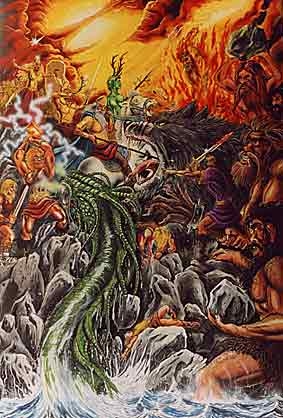
The Old Norse Ragnarøkr: ragna — the genitive of regin — “rulers,” “great ones”; røk — “fate.” Thus, “Ragnarøkr” literally means “the rulers’ fate,” i.e. “the fate of the gods.” The Younger Edda introduced the mistaken rendering “twilight…” or “the twilight of the gods” from Old Icelandic røkkr — “twilight” (e.g., the German Götterdämmerung — notably the title of Richard Wagner’s opera, mistranslated into Russian as “The Demise of the Gods”).
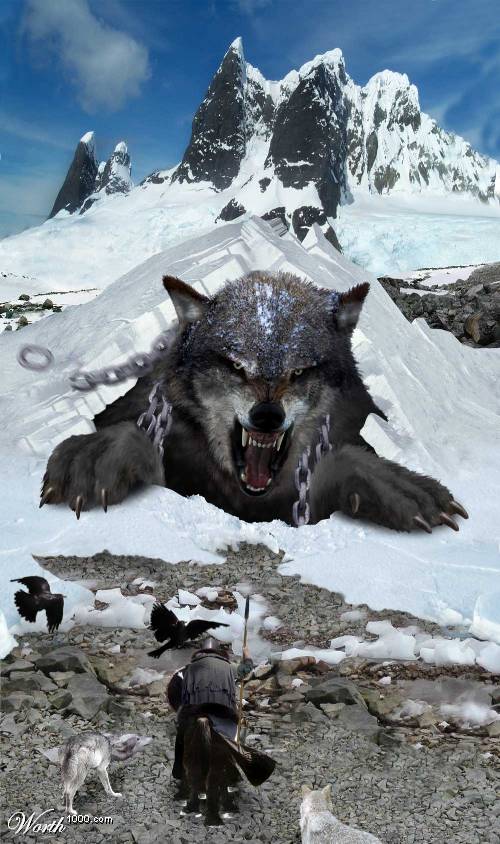
The Eddic tales of Ragnarøkr — the final battle of the gods of the second generation with the thurses — relate a strange episode: the battle begins with the unconquerable Odin, the Great Aesir, charging straight into the maw of the wolf Fenrir, where he dies.
Odin, who slew Ymir, the primal giant; Odin, who won the Mead of Poetry; Odin, who knows past, present, and future — dies a shameful death at the outset of the battle.
And yet he possesses a number of magical “gifts” — the power to be everywhere at once, or at least the power of instantaneous movement; mastery of changing appearance, the faculty of endless metamorphosis; and finally, the power to blind, deafen, paralyze his opponents and render their weapons powerless… But he does not use them during Ragnarøkr.
Moreover, this outcome of the battle is known in advance to the Völva and, apparently, to Odin himself. Odin is not able to influence Fate. But Odin is not one to submit to destiny. He is the eternal fighter — why then does his craft fail him at the decisive moment?
The answer is plain — Odin’s death is a conscious sacrifice.
Just as Ymir’s sacrifice set the world of gods and men in motion, so Odin’s sacrifice lays the foundation of a New Age.
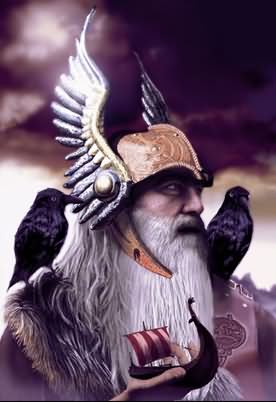
Odin is no stranger to self-sacrifice — he did so twice — offering himself upon the World Tree to gain the Runes and surrendering his eye to the Source of Wisdom.
And the Eddas say that for this sacrifice Odin was apparently blessed by the same Mimir — the Spirit of the World Tree, who himself was sacrificed to the foundations (after the war of the Aesir and the Vanir).
However, it is one thing to give up an eye, and another to go to Hel forever… Indeed, since Odin and the Aesir of the second generation disappear from the scene after Ragnarøkr, it seems they retire to Hel…
Baldr, who dwelt there, on the contrary, returns to life… Or is Baldr — in fact — Odin?
As mentioned, Western notions of reincarnation differ markedly from Eastern ones. In Western myth, reincarnation is the fate of many heroes and gods.
Indeed, Odin is unusually passive in the account of Baldr’s death. At the funeral pyre he whispers something to his son, already dead, and these words turn out to be a terrible secret of the cosmos. Many elements, apart from their kinship, serve to bring father and son closer together.
Thus, in the Saga of the Ynglings Odin appears to us as the most venerated of the gods, and in the “Words of Grímnir” — as “the best of the Aesir.” Likewise, of Baldr it is said that “nothing ill can be told of him. He is the best, and all praise him.” It is also said of Baldr that “he is so fair and radiant that he sheds light.” Odin too is “fair and honorable in appearance.” Furthermore, Baldr is “the wisest of the Aesir and the most eloquent.” Yet the oratorical and poetic gifts of Odin are also widely known — notably from the episode of his gaining the Runes on Yggdrasil. Patron of the two arts, poetry and war, Odin possesses undisputed superiority of spirit and delights in contests of oratory (see the “Sayings of Vafþrúðnir,” where he appears in a contest with Vafþrúðnir, or the “Lay of Harbard,” where Odin (Harbard, i.e., “Grey-beard”) opposes Thor in a verbal duel).
Odin is multifaceted, and it is logical to suppose that Baldr is one of his hypostases — Odin the young, pure, perfect. Baldr would be the “youth,” while Odin is the “elder.” The youthful god embodies the highest degree of order and justice, but an order too perfect, non‑viable. “None of his judgments can come to pass.”
Both Odin and Baldr must be wounded to attain wisdom. The first, upon Yggdrasil, wounds himself with his own spear to open the Runes. The second is mortally wounded at the thing. Yet this death brings about the dusk of the gods or, more precisely, the “fulfillment of the decrees of Fate,” heralding the return of the Golden Age. Baldr, like his father, was aware of what fate awaited him. Going to the thing, he fully knew the doom awaiting him.
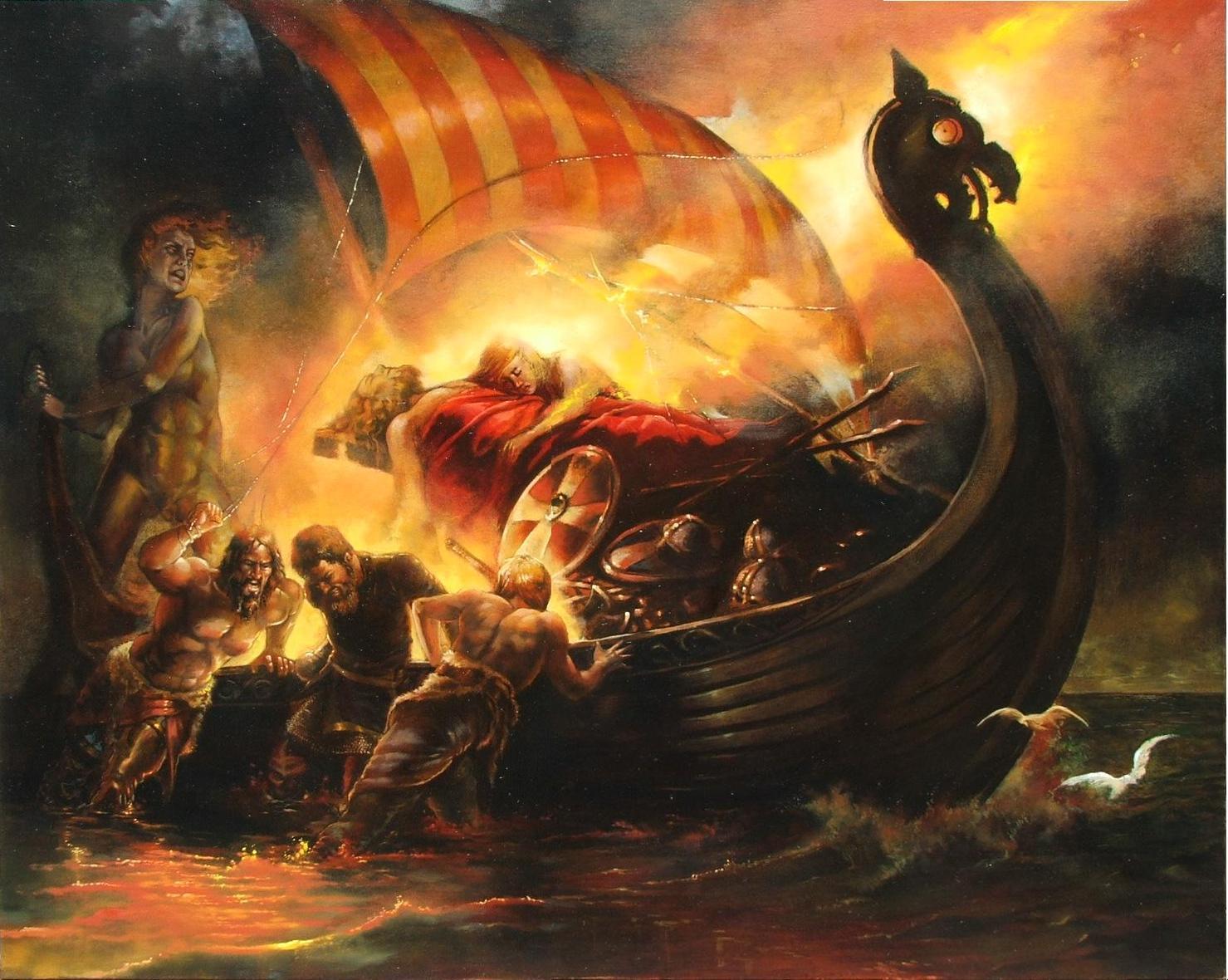
Thus Baldr’s sojourn in Hel is quite justified. He, as the binary counterpart of Odin, exists in an unmanifest state, balancing Odin’s activity in the world of deeds.
Therefore, quite possibly the whole of Ragnarøkr — the renewal, the rejuvenation of the world — was also a rejuvenation of the gods. Odin, merging with Baldr, is reborn as a youth, and with him the veil of weariness and the layers accumulated over the centuries fall away from the whole cosmos.
It is likely that Mimir’s head knew that the rebirth must occur through sacrifice, and Odin heeded its wisdom.
Good publication, the whole Scandinavian mythology in general.
“When the rivers called Elivagar24 moved so far from their source that their poisonous waters froze like slag running from fire and became ice, and when the ice grew firm and stopped flowing, the poison appeared outside as dew and turned into hoarfrost, and this hoarfrost layer by layer filled the World Abyss”. Well said about our consciousness.
Is it possible to view Odin’s sacrifice as a sacrifice to a certain structure, an order in consciousness? The art of changing appearance is the awareness of illusion, the change of identities. To give one’s eye to the source of wisdom means to sacrifice one’s vision of the world, one’s worldview. But it’s unclear what Hel has to do with this? Fall on top?..hm
Numen is Odin’s sacrifice, it is the sacrifice of human consciousness brought by God. Without illusions. Hel knows that Odin knows the source of controlling a human. This source is located in Hel.