
The Wild Hunt
“The Rhine flows merrily, yet its waves
Must hear the voice of war
And the clash of spears among the hills,
And the sound of trumpets afar;
And the brave shall lie on the blood-soaked ground,
For there swept the Wild Hunter!”
(Walter Scott, “The Wild Hunter”)
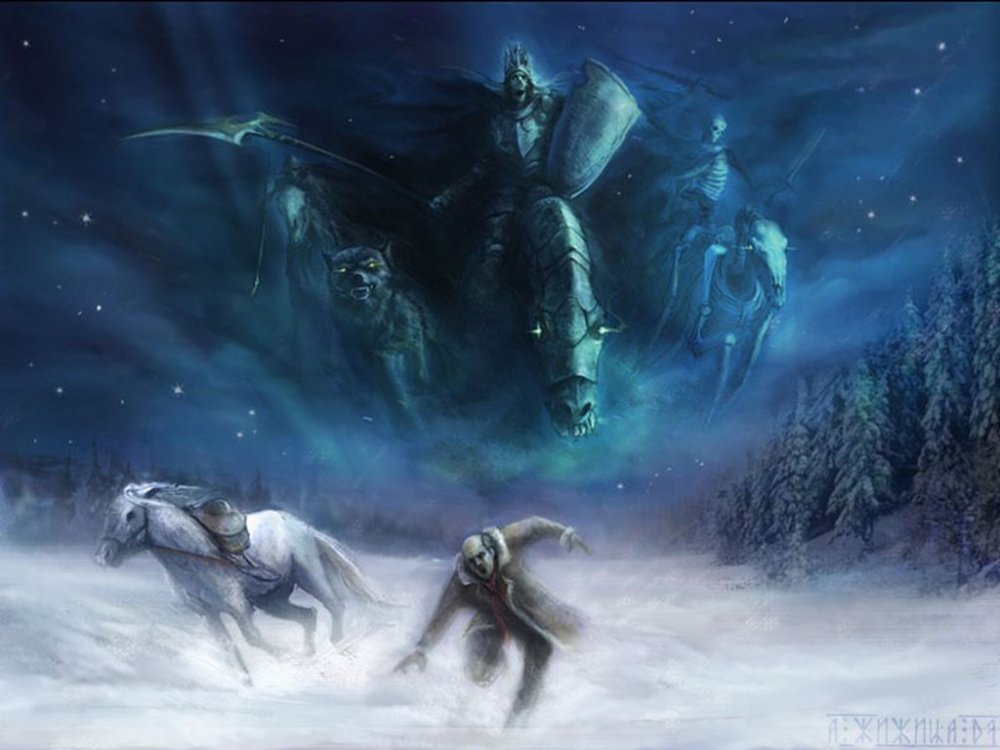
Samhain is approaching, and with it — the Wild Hunter.
The myths of Europe unanimously declare that on the night of November 1 (or thereabouts) a great and gloomy procession sweeps across the world. Much has been written about the Wild Hunt in legends and lore.
The common name — the Wild Hunt — appears everywhere: Wild Hunt, Die Wilde Jagd, Wilde Heer, but there are many local and/or later names as well, for example the Welsh Cŵn Annwn (the hounds of Annwn), Herod’s Hunt, Cain’s Hunt, Gabriel’s Hounds, Asgardreia (Askereia), and so on.
In every region where this legend appears it has transformed, adapting to local beliefs, and there are countless nuances in descriptions of the Wild Hunt.
Many leaders of the Wild Hunt are described, both male and female. In some accounts the Hunt is led, directly or indirectly, by a god; in others the leader is a human — or rather a former human.
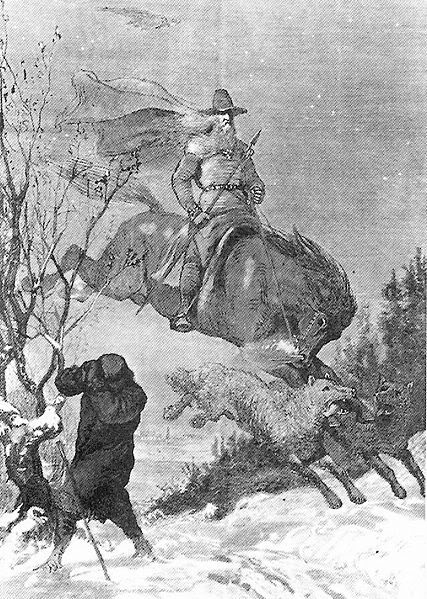
Scandinavians believe that on that night Odin himself rides across the sky leading a host of riders with a pack of baying hounds. His retinue rushes over the land, feasting and scattering debris. Whoever, to his misfortune, meets them is immediately carried off to another realm. And whoever foolishly speaks to them is doomed to death.
In the legends of northern Germany their leader is the woman Holda (Holde, Hulda, Holle, Holte) — a goddess of the household and motherhood. In southern Germany she is traditionally called Bertha (Berhtta, Perchta); the Scandinavian goddess Frigg is also known in this role.
In Mecklenburg it is believed that the Wild Hunter is the goddess Frau Gode, or Wode. She is a feminine form of Odin. She rides a white horse, and her companions take the forms of dogs and various wild beasts. The goddess’s appearance is always considered an omen of great happiness and prosperity.
In Germany, in several variants of the tradition, it is said that an old man called Honest Eckart usually rides ahead of the Hunt, warning: “The Hunt approaches, avert yourselves, people!“.
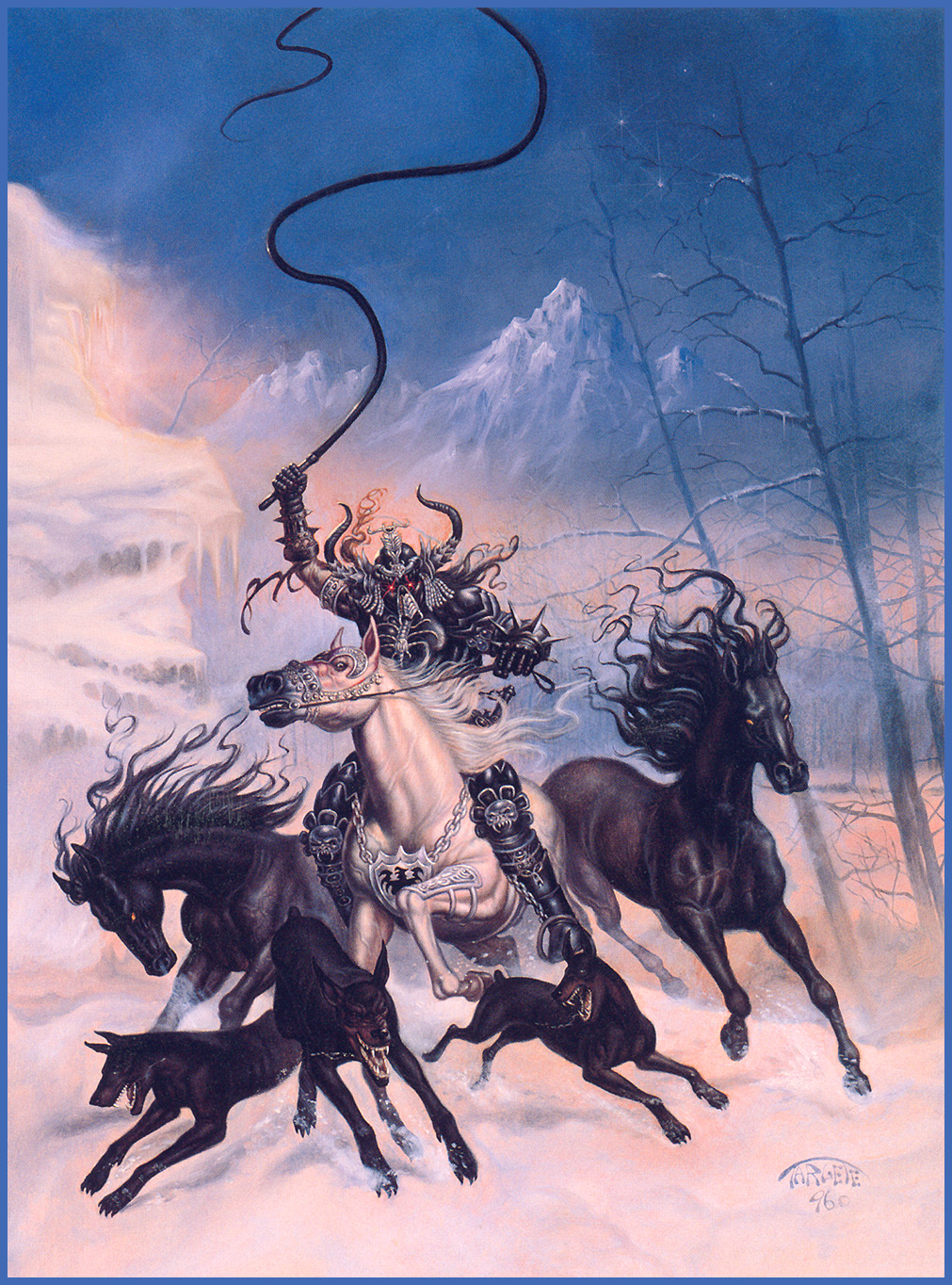
In many cases the Hunter is a man who, however, always has ties both to the world of the living and to the Otherworld, vested with the authority of the Lord of That World: for example, sometimes the wild ride is led by King Arthur — neither alive nor dead, belonging to both the world of the living and Annwn; sometimes by the British king Herla, who lost his time after attending the wedding feast of the king of the Otherworld; sometimes by Edrick the Wild — who married a maiden of the Sí tribe, lost her through carelessness, and found her again after death. Among these heroes are Roland, Sir Francis Drake, Charlemagne, Finn mac Cumhaill, Dietrich of Bern, Valdemar Atterdag, and even a certain Jan Trigigl, a Cornish judge (17th century), who escaped from Hell and took command of the Wild Hunt.
In the north of the Black Forest (Germany) lies the Murg valley, where the Wild Hunter often appears in female form. Dressed in clothes worn three hundred years ago, with a large black hat on her head, the woman rides across the clearings of the Black Forest or hovers through the air on moonlit nights. She rides a black horse, accompanied by a pack of black hounds that breathe fire. Germans believe this is the ghost of Countess Eberstein, punished for a false oath by being condemned to her favorite pursuit for all eternity.
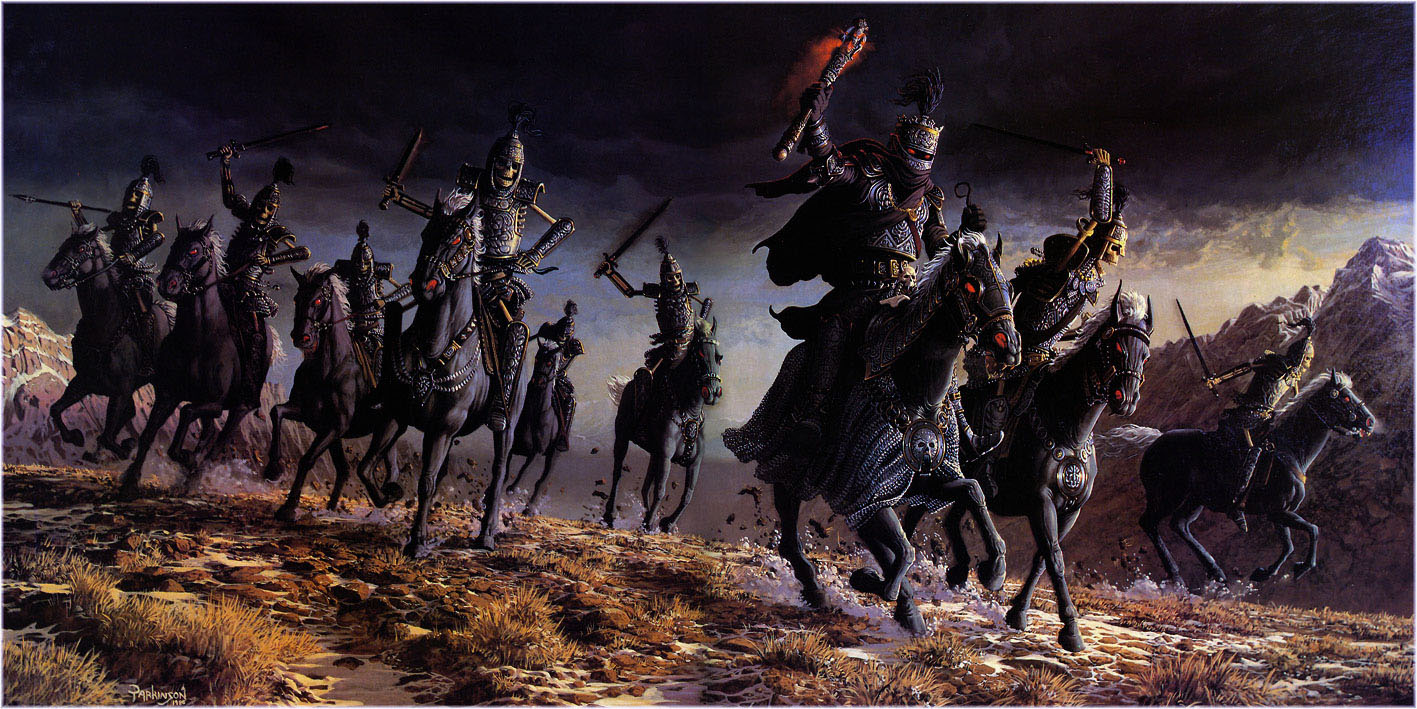
In the Black Forest and in parts of France the Wild Hunter is also identified with Saint Hubert. The thunder of demonic horses’ hooves and the barking of his phantom pack were often heard during harvest and on Saint Hubert’s feast day. Four knights in full armour on horseback fly above the trees and the roofs of houses.
Having passed through the Otherworld and returned, the people — heroes of these tales — themselves acquire the traits of a god — a ruler of the Otherworld, including one of the chief attributes: the ability to open and close the Threshold between the Otherworld and this world.
The Cornish variant of the Wild Hunt — the hounds of Dando the Devil — rush over or above the ground and hunt human souls. Documents of the twelfth century say that there are twenty to thirty hunters, they ride black horses and black stags. With them are black dogs with terrible gleaming eyes.
The people of Cornwall maintain that on stormy nights the sounds of the Wild Hunt can sometimes be heard, far louder than the noise of wind and rain. They sometimes say that the Hunt in that county is led by Lord Trigigl. It is said that this man had committed every crime.
In England one of the symbols of the Hunt is the deer, an unusually white deer. Britain in general has many different variants of this legend.
The Wild Hunt in England is known as Herlathing, after the mythical King Herla, who visited the child-bride of the King of the Fairyland. Another widely known leader of the Wild Hunt was Cernunnos, the horned Celtic god of nature.
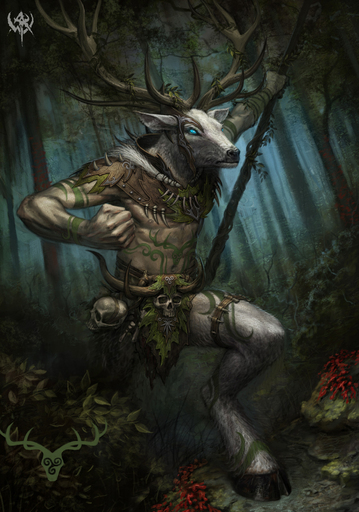
In the tradition of southern England, another horned figure leads the Hunt — Herne the Hunter — God of the Wildwood. Herne’s appearance was believed to foretell great misfortune. When Herne led the Hunt, people hid their cattle and domestic animals indoors, for it was thought that any living creature found outdoors during the Hunt would be pursued and slain.
In Wales the Hunt was led by Arawn — the Welsh god of the Otherworld — also attended by a pack of white hounds with red eyes and ears. There Gwyn ap Nudd, one of the kings of the Fairyland, lord of Tylwyth Teg, rode the Hunt in a grey cloak on a white horse, likewise surrounded by a pack of white hounds with red ears. Among other leaders mentioned were another king of Annwn — Manawydan mac Llŷr, kings of the Fomorians, Bendigeidfran the Blessed and many others.
Among the Slavs the Wild Hunter was Volkh — one manifestation of Veles, and sometimes Semargl in his guise as the Wolf Shepherd.
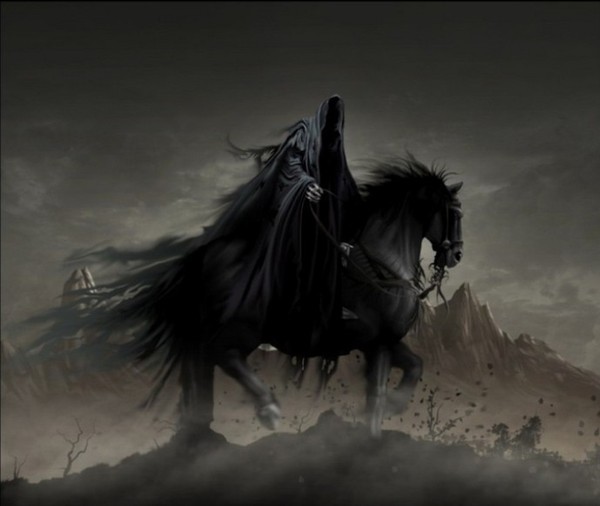
After the Reformation and the Protestant rejection of Purgatory the Wild Hunt became the fate of the unbaptized dead, especially children. The unbaptized could not be buried in consecrated ground; they were buried in the northern part of the churchyard, where it was believed they remained under the earth. They became sport for the hounds of the Wild Hunt, which drove them to Hell.
In Father Bonaventure’s account there are notes about how Father Leslie performed a posthumous miracle: the saint’s remains were buried on this hill, after which the Wild Hunt was no longer seen there.
In contemporary England the Wild Hunt, with its headless pack, is sometimes sighted in Cornwall on the road to Dartmoor.
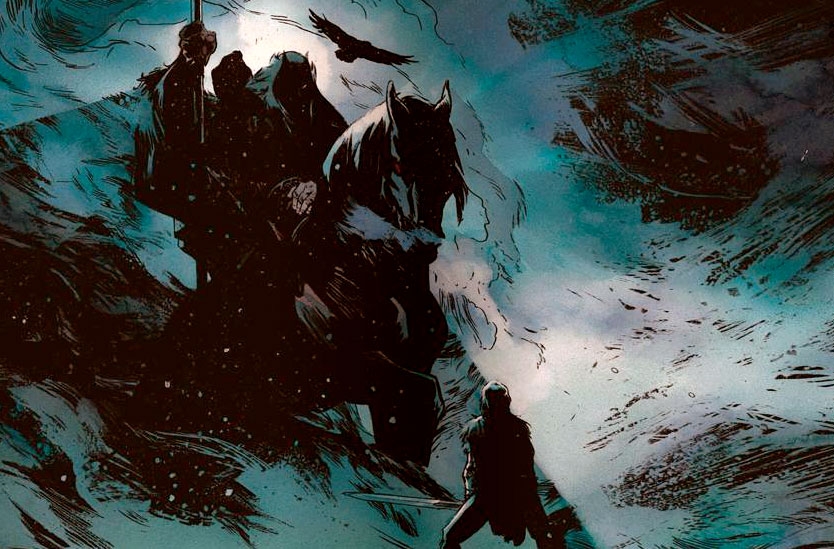
The arrival of the Hunt is always terrifying and accompanied by furious winds and flashes of lightning, the cracking of breaking trees and the ringing of bells ripped from their mountings. The Hunter himself appears accompanied by dead warriors; legends describe him in many ways: with horns on his head, with a skull for a face, or without a face at all. Everywhere the Hunt is attended by a pack of infernal hounds whose baying terrifies people and animals alike.
One common motif characterises almost all regions: to see the Hunt is to invite misfortune — it is a portent of disasters, sometimes even great events such as war, and one must avoid such an encounter at all costs. They said that death comes to those dwellings over which the hounds of Annwn bay on winter nights.
(material on the Hunt: 1,2, 3)
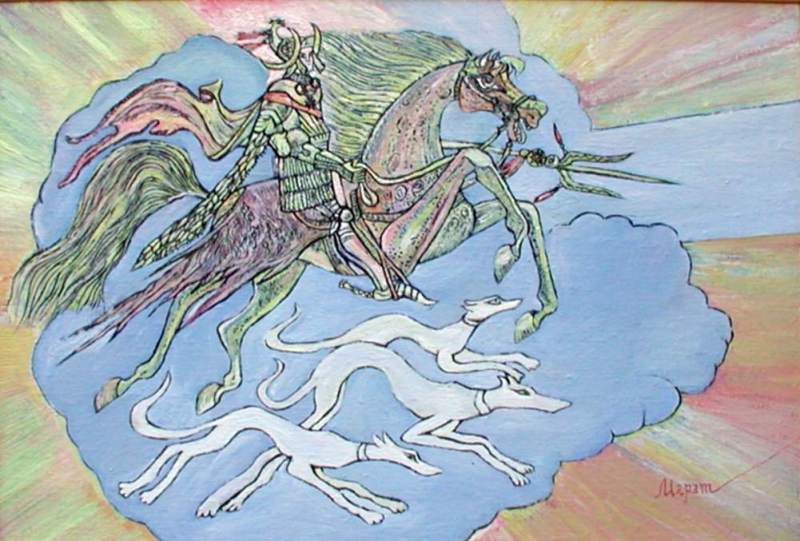
Travellers in lonely places, hearing the approach of the phantom host, would try to throw themselves to the ground, hiding their eyes in fear until the terrifying procession had passed. It was believed the Hunt does not touch those who do not look at it — not surprisingly, the Hunter does not hunt people.
Despite its grim and fearsome reputation, the Wild Hunt is an essential element of the World cycle, preparing nature for renewal. The quarry of the Wild Hunt is not often mentioned, but among Germanic peoples it is most often boar or stag, among the Celts a stag or hare. These are sacrificial animals symbolising rebirth and regeneration. But the main quarry is other.
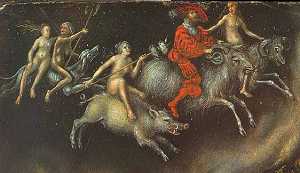
It was believed that throughout the year many souls stuck in the Otherworld and the Interworld crossed the Threshold into the world of the living. Filling the world of the living, these spirits actively used its energy, diminishing its supply and forcing the living to suffer energetic hunger. If this process were not stopped, the whole world, having lost the remainder of its vitality, would fall into the Otherworld, and the living would swell the ranks of wandering predatory spirits. Therefore twice a year, on the nights when the fabric between worlds is especially thin, the Lord of the Threshold rides across the world of the living, catching and driving back the runaway dead. It is no easy work — many souls cross the Threshold and all must be returned to the Otherworld.
Moreover, twice a year two Hunts break into the world — on the eve of Beltane and before Samhain. These two phenomena are similar only in appearance, since both are frightening, infernal and dangerous to anyone who meets them. However, if the May Hunt is a ‘gathering’ ritual in which the Deity of the Threshold herds the undead and beings of darkness back into the Otherworld, the Samhain Hunt, on the contrary, is the first ride of the baneful court. In this sense one can say that the Beltane Hunt is a hunt of the dead, whereas the Samhain Hunt hunts the living.
Accordingly, the May Hunt must not be impeded: it acts at the command of the Watcher, and any ‘anti-magic’ merely opposes the natural course of a mighty current and leads to a loss of energy. The Samhain Hunt must not be provoked: any games, dares, ‘contests of cunning’ that are sometimes recommended are already a contract with the Baneful Court, and one will inevitably have to pay for it with a living soul. For the former symbolic offerings of excess are appropriate (salt and water on the threshold, incense as a ‘bridge’ for spirits); for the latter, conversely, symbols of limit (iron/steel as a reminder of the ‘death of magic’, circles as the establishment of the boundaries of one’s personal universe, a lamp or candle on the windowsill as a symbol of ‘diurnal’ belonging).
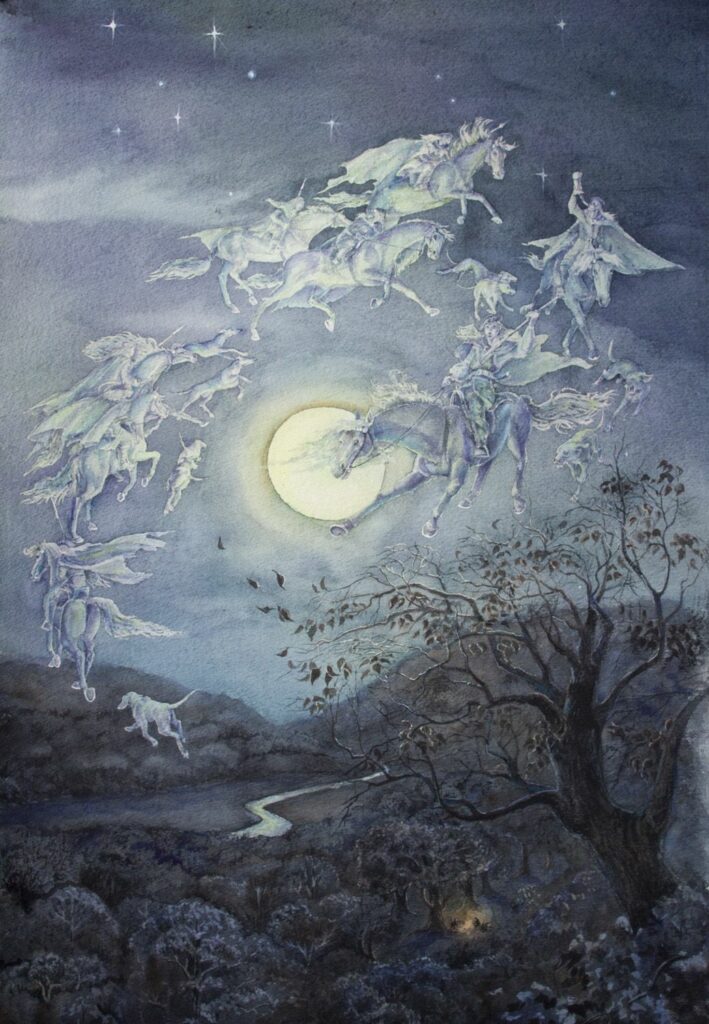
In both cases it is forbidden to turn and ‘look back’ — the gaze fixes attention on the cavalcade, and the traveller remains bound to the Otherworld. After the May Hunt a person more often feels a certain relief, since old spirits are driven away, vampires expelled. After Samhain the outcome may vary greatly: if one has managed to hold one’s boundaries, the integrity of one’s world — one gains an increase of clarity — the experience of passing the Threshold in darkness; but if a ‘breach’ is allowed and a person admits the Hunt into his world or into himself, he loses at least their luck; in the extreme case he joins the nightly running, when the soul becomes part of the Hunt itself and the person either perishes or becomes a ‘supplier’ to feed the baneful, drawing off others’ energy and maiming souls.
However, the Nights of the Hunt did not only presage danger. It was believed that a person — more precisely, a magus, a volkh — could join the Hunt, take part in it, and be rewarded with gifts of power. It was this extremely dangerous but promising enterprise that gave rise to the famous ritual of the ‘Wild Hunt’, practised by druids as an element of Initiation — the pupil had to cross the threshold between worlds and fight spirits that strove to seize his life-force.
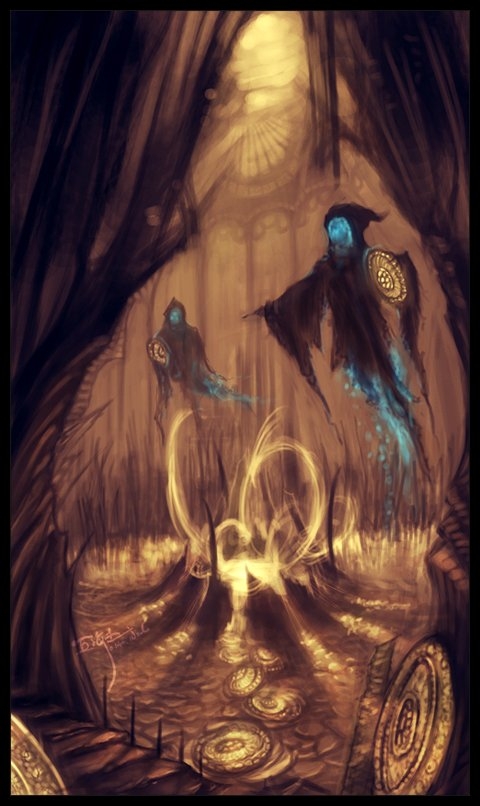
Is there something in common between the ‘wild hunt’ and ‘the hunt for power’? Am I correct in understanding that the wild hunt (for a magician) is one variant of the hunt for power?
Indeed, the ritual of the ‘Wild Hunt’ is one of the variants of the magician’s global Hunt, and this ritual is one of the cornerstones in elemental magic.
How to conduct the ritual of the Wild Hunt?
Is there a correlation between the length of the route and the amount of strength acquired as a result? In a forest, it is not very cozy when it is covered in snow 🙂
I don’t think there is a correlation, but the route must be logical – just stomping on the doorstep won’t do. And no one promised comfort while hunting.
My right forearm hurts after Samhain, quite badly))) I was wandering through the Siberian taiga at that time with beer (at night, of course), but I didn’t see anything special… What to do?
What to do – firstly, Samhain with beer is not the best company… Secondly, try to link Ingwaz with Berkana and make an amulet.
Thanks a lot) So far, I have scratched my hand, it turned out glamorous – symbols reflect each other) Later, I will go to the forest for a pine branch for an amulet. Speaking of hands… I saw one creature… a woman in red… She had runes clearly drawn around her wrists like bracelets as part of the natural skin pattern. I admired her face, but at that time, the sleeves began to lengthen and covered everything. Also, her ankles were ringed and her forehead along the hairline, but the same metamorphoses happened with the cloak and the hem of the dress. So I missed everything about it… But now I know that there are many symbols, much more than twenty-four, although I did not remember any of them. Please don’t send me to Kashchenko, everything happened in a dream)))
What is the holiday of “unclean forces” on May 2?
What if the route passes through a Place of Power or a Portal? How might that influence the process?
It depends on the purpose of the journey. A Place of Power, with the right attitude, can assist in the Hunt, although it can also pose an additional challenge, while a Portal always represents a certain danger.
Elza: In the context of the Wild Hunt, the question symbolically complements…, The key here: 1) This ‘impure’ force is called the Force of Unity (in one of its binary aspects). 2) Without the help of which, the existence-embodiment-birth of those beings who named Her ‘impure’ (confusing the ‘sinful’ with the ‘righteous’) would be in serious doubt. :-)) 3) The Fire of Bela – https://enmerkar.com/en/myth/fire-of-bel
It’s not true. Simargl never took part in the Wild Hunt. Death with the sword that absorbs the souls where a war is planned went on Morovice (the skeletal horse foreshadowing death to animals), Lord Plague, Vyród (this is a freak with three heads, what he eats disappears from the world for 3 years, but the person must give it to him, he does not take money), Khval (causes drought and fires in the woods), Shaludiviy Bunyak (Viy, more precisely, his head). That’s it.
I knew a person who tattooed runes on his arm and then went insane.
In Britain, there is a version that the hunt is led by the king or queen of elves; they could abduct encountered children and young people who became servants of the elves.