
The Three-Faced Father of Worlds
Just as the Maternal Principle lives in its eternal contradiction, the Paternal Principle of the cosmos manifests as a closed triad.
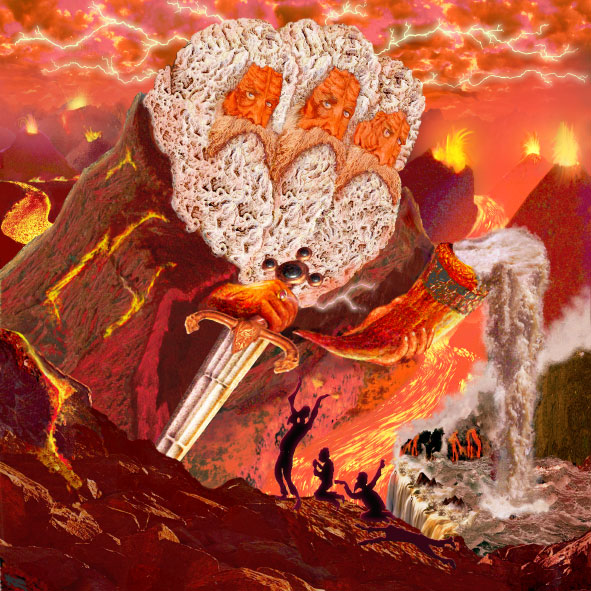
It is commonly held that the Maternal Principle is Material while the Paternal is Spiritual. In mythological systems this is only partly true. The Paternal principle manifests as differentiated multiplicity, while the Maternal appears in undivided Unity. The spirituality attributed to the Paternal principle should be understood as its principle of involution, since differentiation — the movement from the general to the particular — is involution. Likewise, because the movement from the particular to the general is regarded as evolution, the Maternal unifying principle functions as evolving matter. The movement of matter from non-being and back into non-being gives rise to the duality of the Maternal Face, as we have noted.
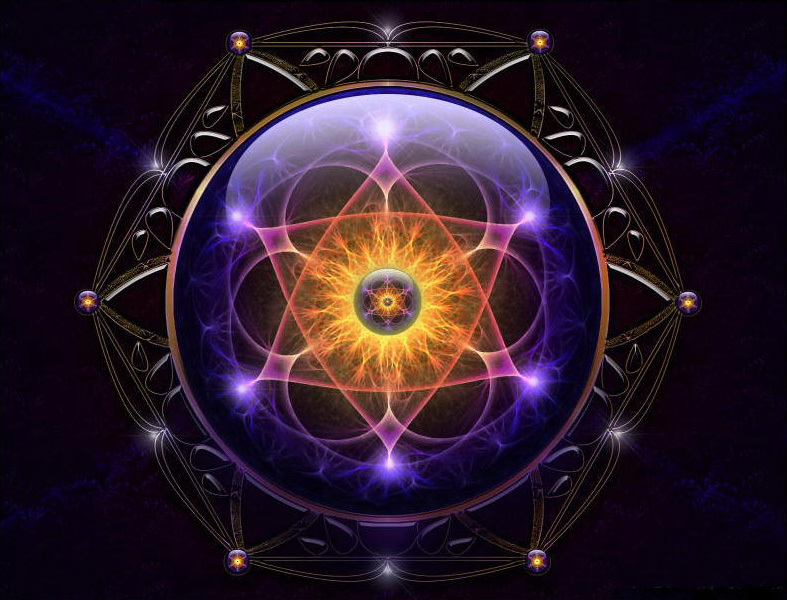
The differentiating Principle consists in specifying ever-new aspects of a phenomenon; its epistemological and thus ontological fragmentation.
Therefore, as soon as the First Duality is born from the Primordial Unity, we witness the manifestations of the Differentiating principle, namely Fatherhood. Hence all mythologies placed the Father above the Mother — not in a hierarchical sense (in which, of course, they are equal as poles), but in the sense of the Primacy of Manifestation. At the stage of Primordial Unity, when the Maternal Principle predominates, there is no manifestation yet; the birth of worlds is precisely the Fragmentation of Unity, and so the Creator is always the Father.
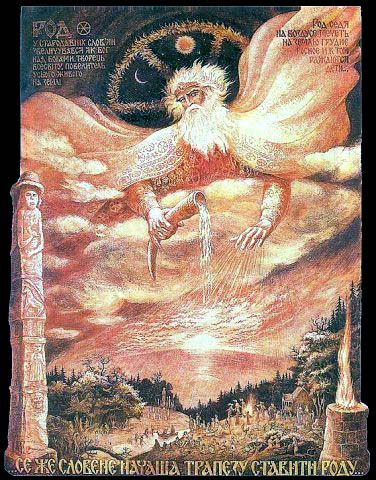
The emerging First Ternary can be considered in several ways. From the point of view of mythology it is important to regard it as the assemblage of a Creator and two Co-creators. Such are Brahma, Vishnu and Shiva of Hinduism; Odin, Lodur and Hoenir (or Odin, Vili and Ve) of the Norse; Zeus, Hades and Poseidon of Classical mythology; and Svarog, Veles and Semargl of the Polans.
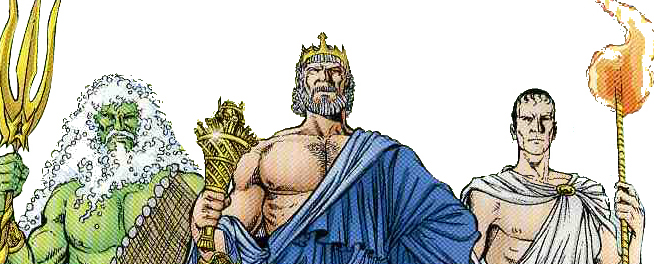
The triune nature of the Creative Deity reflects the harmony of the Ternary (Thesis–Antithesis–Synthesis) of the creative process (Creation–Preservation–Destruction).
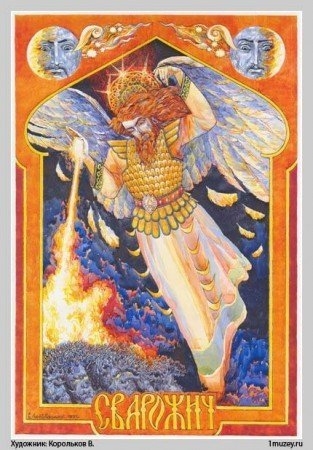
From this point of view it seems justified to identify Hoenir as co-creator alongside Heimdall — the guardian of the universe — and Lodur (as is often done) with Loki. The idea of Semargl as Destroyer seems rather unusual. The role of this god as the “Keeper of the Seeds of All” is well known. However, as a Fire-god, Semargl serves not only as lord of vital force but can also be seen as the Renewing (and therefore destructive) power of Fire.
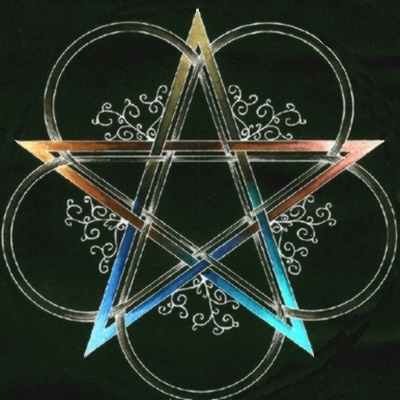
Thus the three-faced father together with the dual mother represent the unity of the creative process, the flow of will within it, which is symbolized by the pentacle.
In general, the interaction of the vertical with the horizontal, understood as a combination of the trinity father and the dual mother, is a particular case of understanding established within the patriarchal system. Given that the central element is androgynous, it can be successfully considered equally as the son of the father and the daughter of the mother. The latter was used among matriarchal cults, where traces of the triune female deity can be found. Such an illustration of the principle 2 + 3 = 3 + 2.