
The Great Goddess of the Tauri
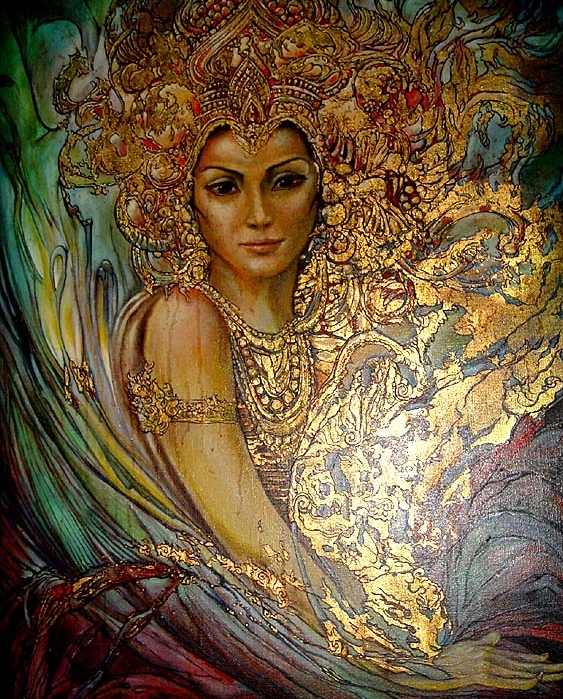
As mentioned, the Great Goddess appeared to her worshippers in two forms — the Benign and the Wrathful. Birth and death, as the two faces of a single flow, fell within Her sphere of activity. We also noted that the Goddess’s duality implies her threefold nature, since her Benign aspect includes two aspects — Generation and Nourishment. Different peoples were chosen to serve her. And peoples left varied descriptions of the Great Goddess.
Thus the Slavs revered Lada — the Mother, Mokosh — the Keeper, and Usonysha — the Reposer. The Scandinavians revered Freya, Frigg, Angrboda. The Scythians — Argipamsa, Api and Tabiti.
We find the serpent-footed goddess among the pre-Scythian populations in the east of the Northern Black Sea region: the Sindi and the Meoti, kin to the Tauri, revered the Great Mother, while the Greeks who lived among them worshipped Aphrodite Apatura (Overcomer of the Waters).
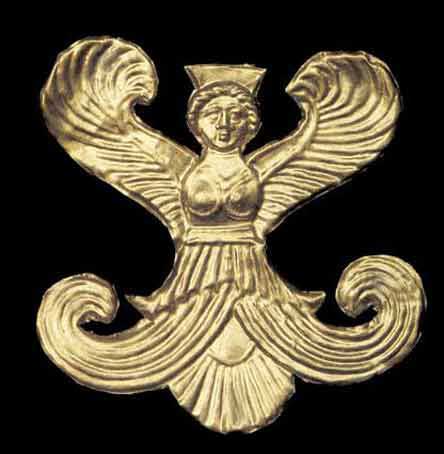
Tauri – the Indo-European earliest settlers of Crimea – also revered the Great Goddess. What the Great Goddess was called in the Tauri is unknown; the Greeks called her Parthenos — the Maiden. She was the great goddess of the earth, of the waters, of all animal and plant life — sovereign of every life and every birth. The cult of the Maiden was widespread in many cities of Asia Minor, from which it could have spread to the Greek colonies of Crimea, as well as into regions of mainland and island Greece. To the colonists of Chersonesus this deity was already familiar from their homeland, at Heraclea; all the easier, then, for them here in Tauris to accept the cult of the Taurian Maiden, who over time became identified with Artemis the huntress.
“They sacrifice Hellenes to the goddess who have been shipwrecked or captured on the open sea. In the sanctuary of the Maiden the victims’ heads are nailed to posts, and the bodies are hurled from a cliff or, according to other accounts, buried. The heads of captive enemies (probably taken in the course of warfare, rather than by robberies), impaled on long poles and displayed above houses, become guardians of the dwelling. The Tauri live by plunder and war,” Herodotus concludes. In the Tauri imagination the Maiden equally patronized both hunting and piracy, both birth and death, thereby embodying the composite image of the Great Goddess.
Accounts of the cult of the bloodthirsty Taurian Goddess formed the basis of the world-famous ancient Greek myth of Iphigenia, sacrificed by her father Agamemnon to the huntress-goddess Artemis so that, under her protection, the expedition against Troy might begin. But on the altar the goddess substituted a hind for Iphigenia, and carried her on a cloud from Hellas to Tauris and made her a priestess there. The myth became the subject of tragedies by Euripides, works by the Italian poet Giovanni Rucellai, the French dramatist Jean Racine, the German poet Johann Wolfgang von Goethe, the composer Christoph Gluck, and the Ukrainian poetess Lesya Ukrayinka.
For centuries archaeologists have searched Tauris for the site where, according to tradition, Iphigenia served at the temple of Artemis. Scholars of the earliest history of Crimea name at least three places where the temple of the Maiden-Artemis may have stood. First, Partenit — the settlement by Ayu-Dag. Its name resembles both in sound and meaning the cape Perteni (Maiden’s), on which the temple of the Maiden is thought to have stood. Second, the area near the former St. George Monastery, where an ancient stone column was once found. And finally, the temple could have been at Chersonesus — a major economic, cultural and political center of the Northern Black Sea in antiquity, the ruins of which today lie within the city of Sevastopol.
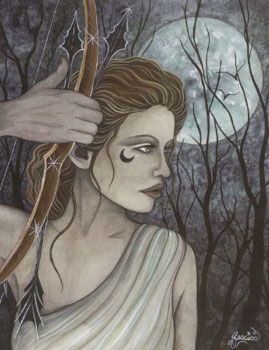
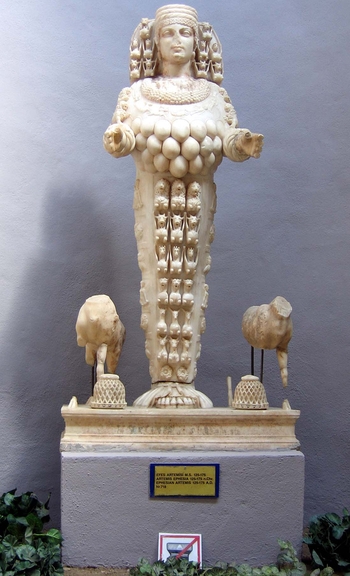
It was likely in ancient Chersonesus that the identification and blending of the cult of the Greek goddess Artemis (and of Iphigenia) with the cult of the local Taurian Goddess took place. It is interesting that the Greeks in Hellas more often called the Maiden Athena rather than Artemis, yet the Taurian goddess was associated by them precisely with the Great Mother of Ephesus. It was in Chersonesus that the Taurian Goddess was called the Maiden, temples, statues and altars were erected to her, special festivals were dedicated to her, she was proclaimed the city’s principal patroness and later its queen. On Chersonesus coins the goddess is depicted with the characteristic attributes of Artemis — a hind and a bow — and the inscription “Parthenos.” In Chersonesus the principal temple was dedicated to this goddess, and the annual festival of Parthenia was celebrated in her honor.
The Chersonesites devoutly believed that the Maiden helped deliver them from all calamities; it is no accident that she is mentioned in the first line of their oath along with the great gods of Heaven, Earth and the Sun — Zeus, Gaia, Helios. The Maiden was, in the view of the Chersonesites, their guardian goddess; and within the first two hundred years of the city’s existence freedom and prosperity were saved from various threats so many times that a chronicle of these events had to be compiled. Thus the city gained its own historiographer — Siriek — who, having carefully studied the temple records and municipal traditions, diligently described all known instances of the goddess’s “miraculous apparitions” to his city in its hour of need. For this labor the Council and the People decreed Siriek be crowned at the Dionysia and to grant him an honorary decree: “The People crown Siriek, son of Heraclides, for having described the manifestations of the Maiden…”. Miraculous and salvific manifestations of the Maiden accompanied the dramatic chronicle of Chersonesus’s relations with neighboring peoples and states.
However, the Maiden of Chersonesus was already a Hellenized variant of the Tauri Great Mother. Although the Greeks acknowledged in her the union of the benignant and wrathful aspects, they nevertheless did not perceive in that union the intensity and drama that the Tauri perceived. Faith in the Goddess’s power, love for her and fear of her wrath filled the spiritual world of the hill- and forest-dwellers (for the Tauri lived primarily there; unlike the Scythians, the Sarmatians and other Iranic-speaking tribes they were not steppe peoples).
But why did the Tauri see the Goddess as one? Why did not separate Her hypostases occur in their mind? As heirs of megalithic cultures, the Tauri perceived the flow of power differently from later peoples. They were surrounded on all sides by forests and mountains, and such a life in an enclosed, relatively sheltered (like a mother’s womb) and at the same time harsh landscape made their mindset more holistic than the minds of the Greeks or Scandinavians, accustomed to the sea expanses, or of the Scythians — kings of the steppe.
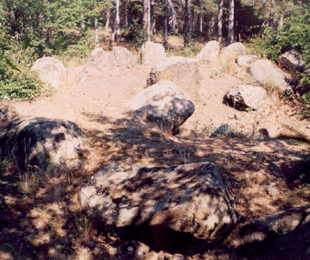
Therefore the forest Cromlechs (stone circles) of the Tauri were associated not with a solar cult (as is often thought) but with the cult of the Goddess; and many Taurian sanctuaries were located in caves (also associated with the mother’s womb). Therefore they offered human sacrifices to the Goddess: by taking the life of a victim, the goddess could grant new life in exchange — to the tribe, to the herd, to the orchard.
Thus the spiritual world of the Tauri was entirely under the sway of the Goddess’s Power. Solar altars on mountain summits, dedicated to the Heavenly Father, never inspired as much devotion as the forest and cave sanctuaries, and the Heavenly god himself (of whose worship we have little record) was seen only as a necessary complement to the Great Mother.
Thank you. Well said.
“We worship the Virgin and now! She exists!”
Glory to the LINEAGE!!! The Taurans did not bring bloody sacrifices to the Virgin! This lie was spread by the ancient Greeks and Romans to discredit the Taurans!
It might be appropriate here to mention also the Hindu female deities (Parvati, Kali, Durga), now our Rodnovers draw direct analogies with Lada, Makosh… and use certain practices of Hinduism… see “Kālagni-tantra” of Satyavan.
Do you think that when Homer wrote about the sacrifice of Iphigenia, he was also trying to discredit someone? Everyone did this in times of acute necessity, and the Taurans were hardly a white fluffy exception 🙂
The ancient Greeks were very arrogant towards others; and they attributed their unseemly actions to the conquered peoples to justify their barbaric methods of governance! By tarnishing the Taurians and attributing their bloody sacrifices to them – this justified their colonization of the Crimean coast!!! There is a legend *THE TEMPLE OF THE GOLDEN CRADLE* which was printed and retold by Alexander Stepanov: it is very interestingly stated about the Sindans of the Tauric (Taurians)!!!
The ancient Greeks were very arrogant towards others; and they attributed their unseemly deeds to the conquered peoples to justify their barbaric methods of governance!
By defaming the Taurians, attributing their bloody sacrifices to them — they justified their colonization of the Crimean coast!!!
There is a tale *THE TEMPLE OF THE GOLDEN CRADLE*
which was published and retold by Alexander Stepanov: read, it is very interesting about the Sindans of Tauris (Taurians)!!!
Perhaps remnants of the Tauric megalithic culture are located on the Tarhankut Peninsula (Black Sea region of Crimea). I managed to take many pictures of stone drawings and megalithic structures in 2011-2012, evidence of the connection between Tauric culture and the megalithic cultures of ancient Crimea. Anyone interested can contact me for photos and my own comments.
Gennady, please send the photos and your own comments that you mentioned (Gennady:
Saturday, July 28, 2012, at 11:20 PM
Perhaps the remnants of the Taurian megalithic culture are located on the Tarkhankut Peninsula (Black Sea region of Crimea). In 2011-2012, I managed to take numerous photographs of stone drawings and megalithic structures that testify to the connection of the Taurian culture with the megalithic cultures of ancient Crimea. To everyone who is interested, I can send photos and my own comments.)
That’s not quite right; rather, it’s not right at all. Read the Scythian secret writing ‘Milestones of the Vedas’!
Good job. And beautiful comments = each one a little masterpiece and a sparkle of erudition. I dream of writing a sketch about the Taurian Virgo. If anyone knows myths about her, please send them. Thank you in advance, Yuri Alexandrov.
Why did the Taurians see the Goddess as one? I agree with the author’s opinion. This is how the Great Goddess was perceived by other nations in Europe before the patriarchal era set in, when the Great Goddess was “overthrown” from her pedestal in the consciousness of ancient people, fragmented into powerful and formidable parts, but never again superior to the male god, while the symbol of the Great Goddess—the Serpent—was demonized and diminished.
The Great Goddess has many names. I particularly like “Mother Life-Death-Life.” It reveals that this Goddess does not simply have two faces. She spins the wheel of life and death, lives through cycles, and after death, life always follows.
The image of the Mother Goddess is a “projection” of a mature stage of a woman’s life, as opposed to the two others – the image of the young Maiden and the old Ancestral Mother.
All secrets are kept in the Stavropol Regional Museum, under 7 locks.
All documents on the Scythians and tauriforms were hidden in 1908 in the Stavropol Museum, and to this day everything is kept in the museum’s archives. It is there that the secrets are hidden.
Andrey, where did you even get the information about the connection between the Tavrs and the Stavropol Museum? Could you provide some links? I have been studying this topic for a long time, but I haven’t heard about it.