
Tabiti — Queen of Queens
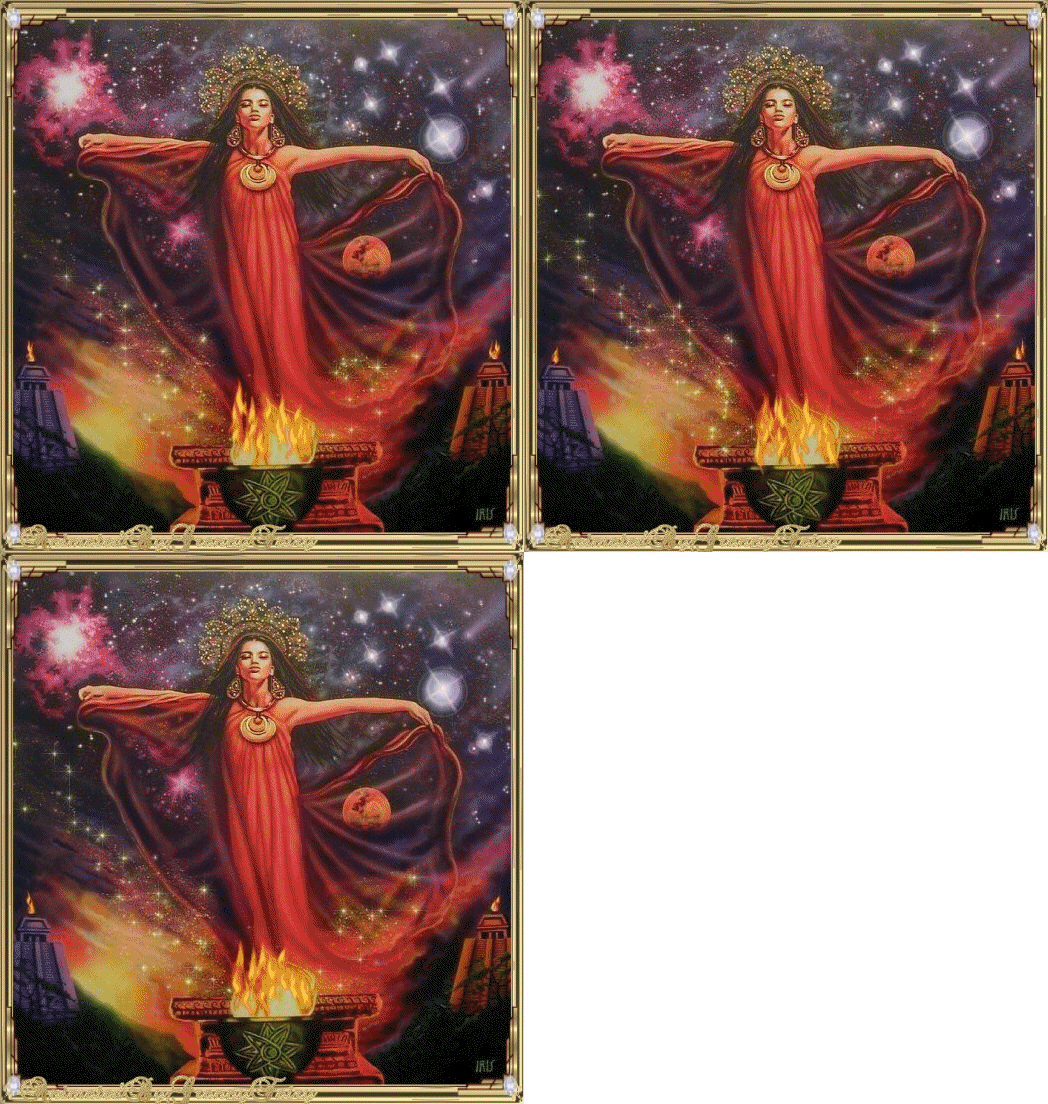
No one — neither king nor god — could violate the immutable canons and institutions of Scythian society and state with impunity. For standing guard over the ancient orders, traditions, and customs of the Scythian household, family, and community was the most revered, all-powerful Goddess, Tabiti. Administering the highest judgment and supreme justice is Tabiti’s chief function.
Among the Scythian gods seven held preeminent positions, as Herodotus clearly recorded. Let us recall a passage from the account by Herodotus of the “father of history.” “The Scythians worship only the following gods,” testified Herodotus. “First of all Hestia, then Zeus and Ge (Ge is regarded by them as the wife of Zeus): after them Apollo and Heavenly Aphrodite, Heracles and Ares. These gods are worshipped by all the Scythians, and the so-called royal Scythians also make sacrifices to Poseidon. In the Scythian language Hestia is called Tabiti, Zeus (and, in my opinion quite rightly) is Papai, Ge is Api, Apollo is Goitosyr, Heavenly Aphrodite is Argimpasa, Poseidon is Phagimassad”
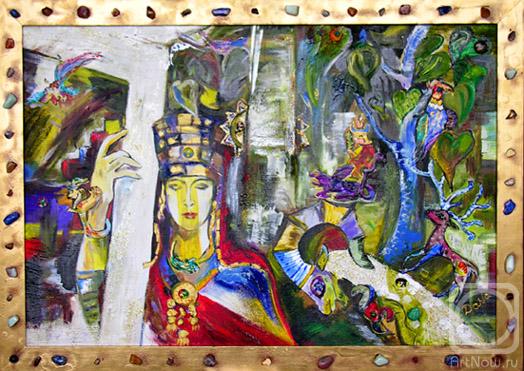
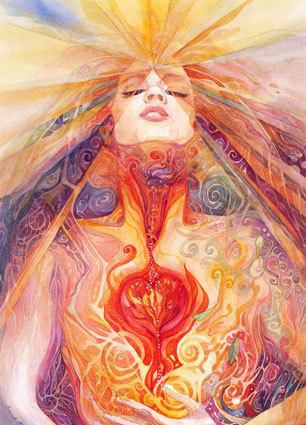
Tabiti was called “the Queen of the Scythians”; she appears as the lady goddess of the subterranean fire. She is a formidable, “enkindling” Goddess, whose various functions included patronage of the household fire, the sacrificial fire, and therefore also of prayer. Tabiti ensured the unity of the social order and was likewise closely connected with the earth and its role in renewal. Hence her mystery and manifold nature, her numerous transformations and transmigrations. Hence the “right of inviolability” accorded to certain secret sanctuaries associated with her, known in the Black Sea region, including the mountains and steppes of Crimea. Tabiti’s functions as a deity that binds the universe into a single whole bring her close not only to the Great Goddesses but also to unifying gods — specifically, the Slavic deity Semargl. Incidentally, the latter was also a fire deity.
Tabiti was venerated by the Scythians above all other gods and constituted as a single entity the first of the three ranks of the seven-god pantheon. Herodotus’s reference to the existence of multiple “royal Hestias,” by whom the highest oaths were sworn, accords with the idea of fire as a principle connected with all three zones of the cosmos, as the primeval substance in the process of cosmogony.
The great Scythian goddesses Tabiti and Api were united in their divine functions. But Herodotus named Tabiti first and highest in rank, and in the second place Papai (the heavenly god) and Api (the Goddess of the Earth). He cites King Idanthyrsus’s letter to Darius, in which he calls Hestia/Tabiti “the Queen of the Scythians.” Herodotus recorded: “if the Scythians wish to take a particularly sacred oath, they usually solemnly swear by the gods of the royal hearth.” Anyone who violated such an oath was killed, and thus offered as a sacrifice. The Scythians pictured Tabiti as a young woman in a long dress. Tabiti always carried a magic mirror in which she observed the world, and where all human destinies were reflected.
At the same time, in Herodotus’s time Scythian society was by no means matriarchal. Men led Scythian tribes and clans, whose names are known to us from Herodotus and other authors. Descent was traced through the father, not the mother. Yet it is the Goddess — Tabiti — who is most closely tied to the Scythian society, directly involved in securing the welfare of their lives, entering a sacred marriage to their chieftain. Api, by contrast, appears as the earth, the soil, the Underworld. Within her is concentrated the primal energy that nourishes all earthly life. She is a sacred element in the vertical hierarchy of the Universe, a dominant element, but not as intimate as Tabiti. As the Mother of the Scythian kings, Tabiti also fulfilled the role of protector of the sacred graves of the Scythian ancestors.
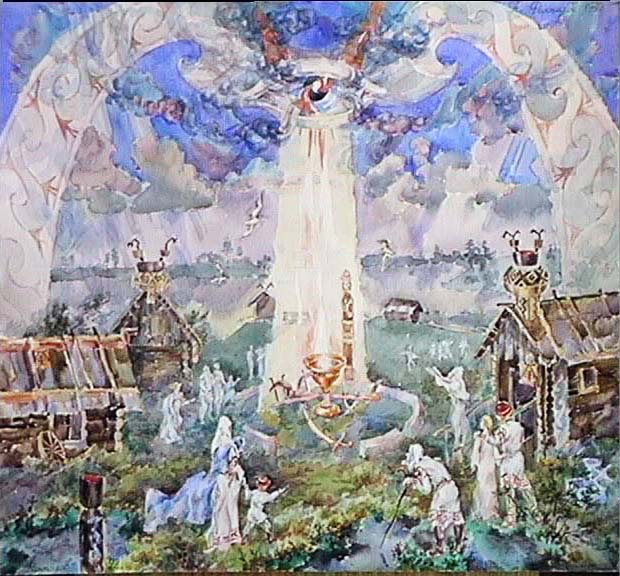
As multiple embodiments of Tabiti one may consider the golden objects that fell from the sky and were capable of ignition: the plough with its yoke, the axe, and the cup, symbolizing the three social groups of Scythian society and, through their progenitors Lipoxais, Arpoxais, and Kolaxais, the three zones of the cosmos they personify. Among her symbols are three fires reflecting the tripartite cosmos. The appellation of Tabiti as “the Queen of the Scythians” indirectly points to her role as the king’s consort, to the existence among the Scythians of a ritual of symbolic marriage of the king to Tabiti, intended to confirm the sacred character of royal authority. Herodotus’s account reflects the account of the first Scythian king Kolaxais’s acquisition of the golden objects. These objects received annual sacrifices from the Scythian kings. Simultaneously, the ritual of the king’s symbolic marriage to the “Queen of the Scythians” Tabiti was performed, in which the king pledged fidelity to Tabiti’s traditions and laws established and protected by Tabiti. Violation of these laws, however, was punished by death. Thus, according to Herodotus, the Scythian king Anacharsis (the paternal uncle of King Idanthyrsus) perished after abandoning ancestral customs and holding festivities in honor of Cybele — the Great Mother of the gods. For his adherence to Greek customs and religion the Scythians deprived King Skyles of his power and had him beheaded.
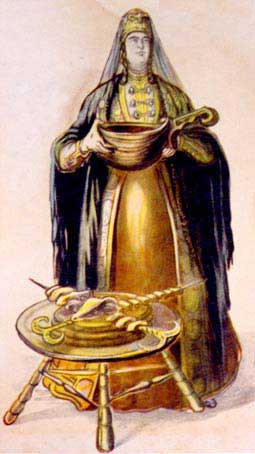
As the Goddess of Fire, Tabiti was mistress of every hearth; it was believed that every fire, especially the household hearth, was sacred because Tabiti dwelt there. Every feast or celebration among the Scythians began with making offerings to her. For this purpose, before drinking the first cup of wine, a little of it was poured into the fire so that Tabiti would also share in the festivities. Otherwise the mighty goddess could be offended and wreak terrible vengeance. Since the Scythian kings were regarded as the chief servants of Tabiti, they conducted all the festivals and principal sacrifices for this goddess. The royal hearth was considered sacred among the Scythians; Tabiti constantly lived there and guarded the king’s subjects from misfortune and calamity.
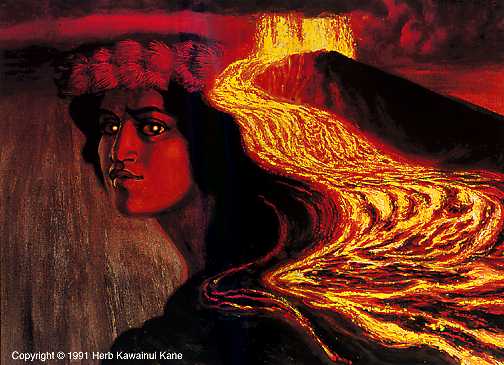
Thus, a female deity headed the pantheon. Herodotus’s report is fully corroborated by Scytho-Sarmatian archaeological data. According to archaeologists, “the archaeological evidence supports the view that the supreme deity worshipped by the Scythians was a sovereign goddess…” This trait also characterizes the religious life of the Bosporan Kingdom. There too “one cult — the old local cult of the great supreme goddess — predominates, almost suppressing the others.” Yet this goddess is fiery, mighty, and sovereign; she is not primarily a mother goddess but precisely a Queen, a ruler. Like other fiery goddesses — such as Brigitta of the Celts or Pele of the indigenous peoples — Tabiti embodied the entire world-order, the whole universe in its original fiery creative nature. When Scythian kings ascended the throne they entered into a sacred marriage with the goddess and thereby received authority from her.
Very interesting article. Thank you. In your opinion, can we talk about the different nature of the awareness of Power among different peoples? For the Greeks, Hestia left Olympus, conceding her place to Dionysus in a moment of self-humiliation, voluntarily. Among the Scythians, on the contrary, she acquired an aspect of power and will, meaning she took the place that Zeus held among the Greeks, and Jupiter among the Romans.
What do you think?
In Slavic myth, the goddess of fire and spring is Vesta, popular but not the strongest goddess.
In Tabiti, one can trace Elbereth (Varda) from Tolkien’s epic; she is also represented by the Tarot card “The High Priestess” (Queen of Heaven). She did not lead the pantheon, but indeed, she was revered by both Elves and Aryans in pre-flood times. Elbereth is the creator and mistress of the stars; her element is light, which manifests the entire universe from nothingness, hence her power in relation to other gods. This is also connected to the magical attribute – the all-seeing mirror. At a lower level of creation, she was represented by Lúthien Tinúviel, the wife of the human incarnation of the Almighty – Beren, and an even later story involves Aragorn and Arwen, from whose union the line of True Kings is derived…)))