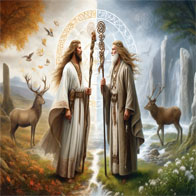
If a Runic magus is an agent who acts upon the world and actively transforms it, then the magus of Ogham is a power that sustains natural processes and flows with their course.
Other Magic
Пишите мне
Enmerkar's Blog содержит более тысячи авторских статей эзотерической направленности.
Введите интересующий Вас запрос — и Вы найдете нужный для Вас материал
If a Runic magus is an agent who acts upon the world and actively transforms it, then the magus of Ogham is a power that sustains natural processes and flows with their course.
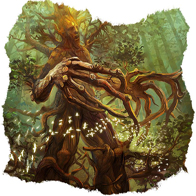
The Druids learned to discern the characteristic qualities of most energetically active plants, to awaken their Powers, and to employ those energies as a means of bringing into harmony their own manifestations, and the places and worlds in which they happened to find themselves.
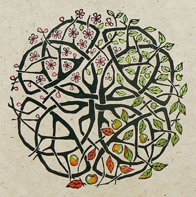
A knitted ornament can be regarded as the ‘trajectory’ of realization, and the creation of such a weave as the establishment of its ‘route’.
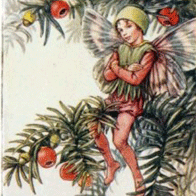
The fourth Akme is devoted to examining the interaction of this system with its surroundings, its influence upon that environment, which is conceived as the medium for that influence.
The third family of the Ogham is devoted to the “power of branching,” that is—the capacity of a system to generate currents and impulses that diverge from its main flow without losing connection to it.
The akme of the Hawthorn outlines the changes occurring at the stage of a system’s “maturing”, its transition from frightened-new to a stationary state of existence.
The first akme encompasses the initial stage of the “birth” of a system’s energetic activity: the emergence of its own properties and characteristic features.
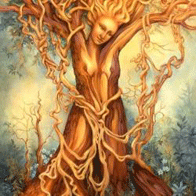
By examining the separate stages according to the nature of the plants, one can not only understand the characteristics of the “inner” life of a flow of Power, but also uncover the “hidden” levers for guiding its currents.
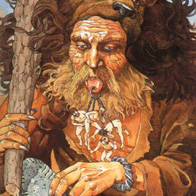
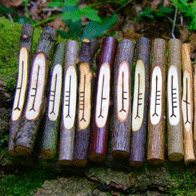
The alphabetic system that emerged after the Departure of the Fairies into the Sid in the British Isles was Ogham. Although the earliest Ogham inscriptions date to the fourth century, the system probably goes back to much earlier times; nevertheless it was for a long period scarcely used for writing — indeed, the vast majority of Ogham inscriptions are funerary: epitaphs and sometimes fragments of spells.