Music of the Spheres
It is perfectly obvious that any magical Ritual is, in fact, reducible to a combination of three components: movements, symbols, and sounds.
Moreover, the success of an implementation depends on their suitability to the goal and how skillfully and harmoniously all the components are selected — not only according to the formal logic of the Ritual but also with regard to implicit factors, which is particularly challenging for the sound elements.
The idea that sound possesses a creative power reaches back to the hoary Pythagorean teachings.
In ancient Mesopotamia, people believed that the celestial bodies perform a cosmic hymn as they move across the sky.
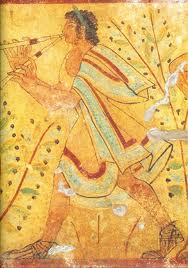
Pythagoras cured many diseases with specially composed music, calling this therapy “musical medicine,” since he associated the notion of catharsis with music, which he recommended for the purification of the soul. Pythagoras believed that each person, as with each planet in the cosmos, has his own music — the music of his spheres.
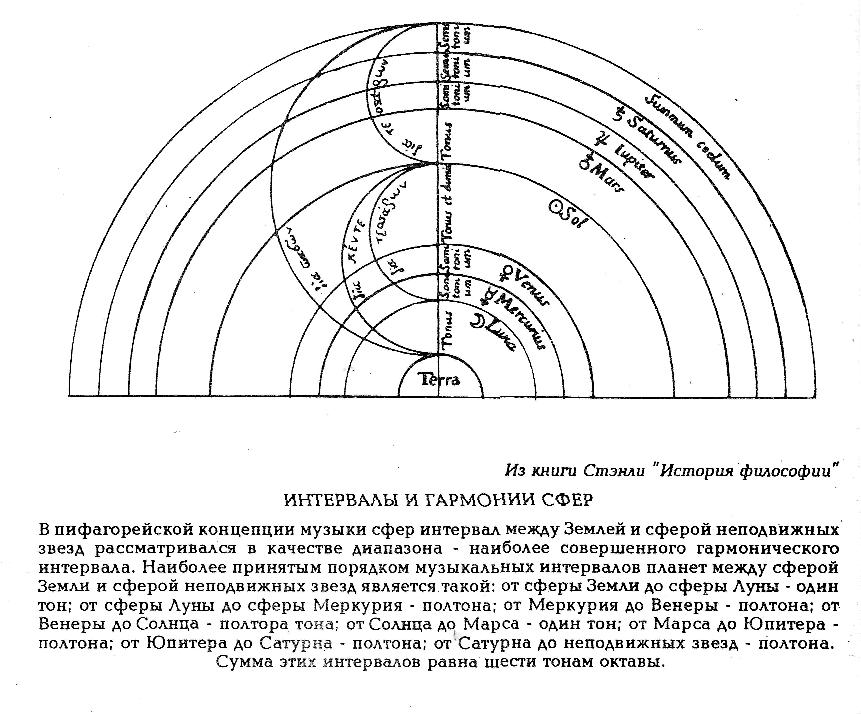
For Pythagoras, music was derived from the divine science of mathematics, and its harmonies were strictly governed by mathematical proportions. He divided the many parts of creation into a large number of planes or spheres, each of which he ascribed a tone, a harmonic interval, a number, a name, a color, and a form.
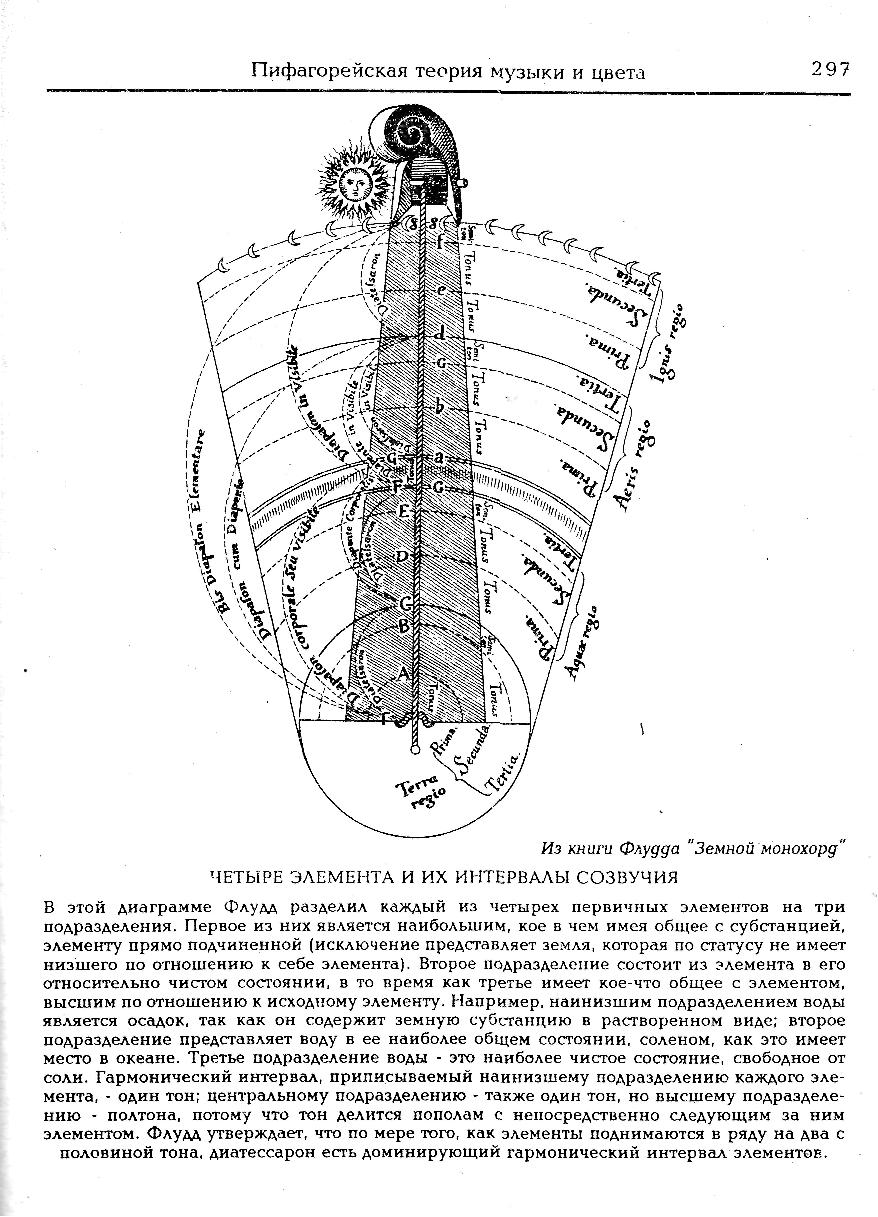
Having established music as an exact science, Pythagoras applied the laws of harmonic relations he had discovered to all the phenomena of nature, and thereby established harmonic relations among the planets, constellations, and elements.
Pythagoras regarded the Universe as a monochord with a single string, its upper end attached to the Great Spirit and its lower end to absolute matter.
The Pythagoreans gave names to the different notes of the diatonic scale based on the speed and magnitude of planetary bodies, each of which they held to emit a sound of a particular pitch.
The Greeks also recognized a fundamental correspondence between the separate spheres of the seven planets and the seven sacred vowel sounds. The first heaven pronounces the sacred vowel A (Alpha); the second heaven, the sacred vowel E (Epsilon); the third, H (Eta); the fourth, I (Iota); the fifth, O (Omicron); the sixth, Y (Upsilon); the seventh heaven, the sacred vowel O (Omega). When the seven heavens sing together, they produce a perfect harmony that rises as eternal glory to the Creator’s Throne.
On this basis, the Names of God were conceived as forms formed from combinations of the seven planetary harmonies.
The ancient Egyptians restricted their sacred songs to the seven primary sounds, forbidding other sounds to be uttered in the temple. One of their hymns contained the following incantation:
“Seven sonic tones give praise to You, Great God, the ever-creating Father of the whole universe.”
In another hymn, the Deity describes Himself thus:
“I am the great indestructible lyre of the whole world, tuned to the songs of the heavens.”
The Pythagoreans believed that everything that exists has a voice and that all creatures eternally sing praise to the Creator.
Man was unable to retain these melodies within himself, because his soul became entangled in the illusion of material existence.
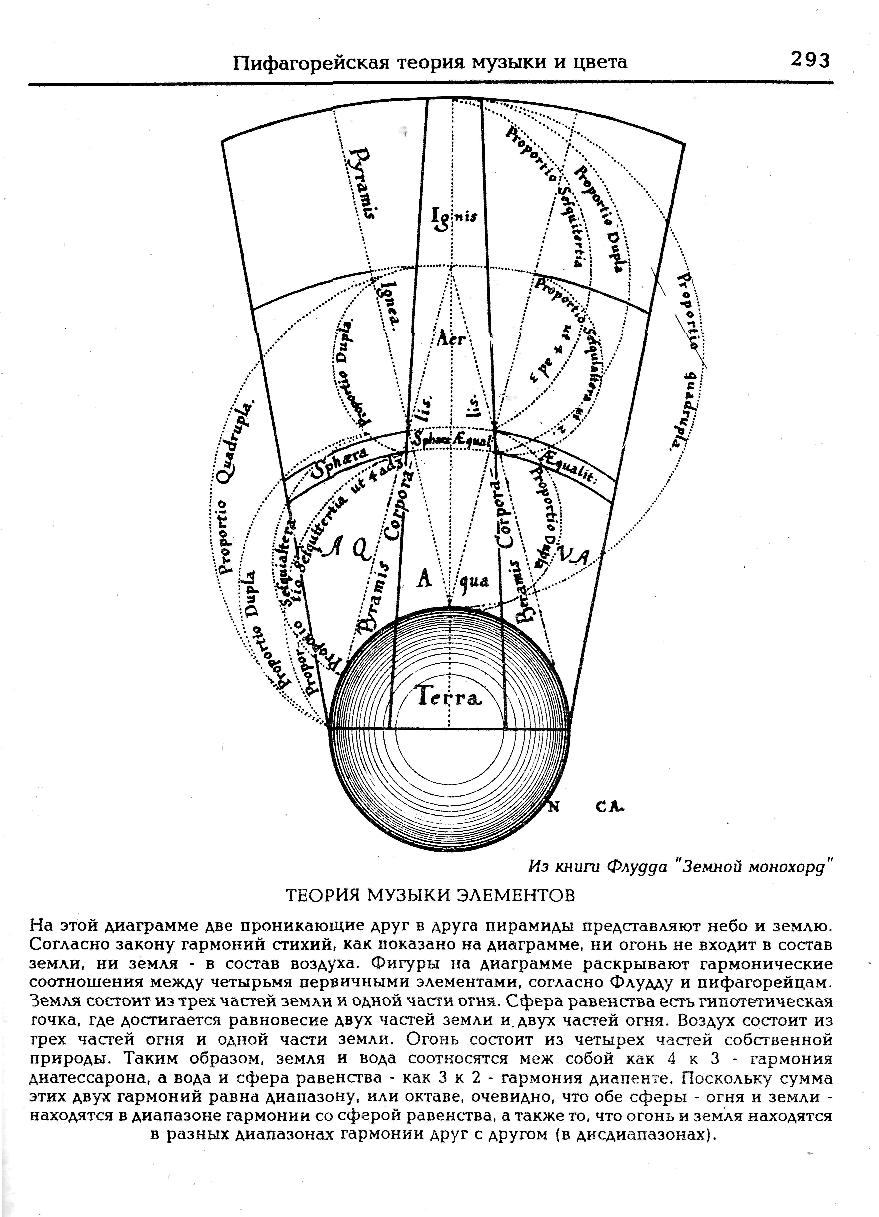
The Greek Mysteries included a doctrine of the correspondence between music and form. The rituals of the Mysteries incorporated special vocal effects in the enunciation of phrases, and for this purpose, special sound chambers were constructed. A word whispered in such a chamber would fill the entire building with an almost thunderous roar.
It is held that every element in nature has its own key. If these elements are combined into a complex structure, the result is a string which, when sounded, will cause the constituent parts to disintegrate. In the same way, every object, creature, and person has its own key so that when sounded, the object will be destroyed, or, conversely, transformed. The same idea underlies the power of Elvish songs that are in accord with the Music of the Cosmos.
It is precisely the application of such “key” sounds that underlies most sound spells, as well as the technique of “vibrating” the Divine Names and Words of Power, practised in certain schools of modern Western Magic.
Thus, when constructing a ritual, it is important to understand which sounds are used in it, how they interact with one another and with the practitioner’s state, and how appropriate they are to the goal and the method of execution.
Thank you for the interesting material. One can draw several charming parallels with string theory.
Good day. I apologize if this is off-topic; I just had a thought and would be interested to hear your opinion. In general, the thought is this: music can be different, and 90% of the music being created today (like pop, for example) aims to evoke a range of emotions in the listener, to make them “feel” it. However, I find it interesting that there can be a significant distractor in this context. The idea is that when a person experiences such an emotional surge, they expend a lot of energy on something they want to feel (but haven’t truly felt), and where does all that energy from such “emotions” go? Most likely, it feeds the internal predator, as such expenditure seems pointless. It’s not just music; I encounter similar provocateurs of plastic feelings every day, and I sometimes find myself starting to “feel sad” or “feel happy” almost by default. I’ve tried to create inner silence, but I can’t maintain it for long. Perhaps magicians have noticed something similar? Are there effective ways to combat this?
And what if we imagine that there is no such surge of emotions? What will we end up with? A zombie, blankly staring at the television and chewing on a meat patty? We need to think about what kind of music. Pop music cultivates nothing but ugliness and feeds not only the Predator. However, there are other directions that awaken a call to action in the soul, remind you of who you are, and help push you forward, towards understanding another’s pain and delving deeper into yourself. Should we also exclude the emotions that drive us forward? It seems to me that it’s best to simply control them, channel them into productive actions, and direct them towards self-development. And then ask yourself, as a teacher once asked: “So, now tell me, what did you feel? How can you apply this? Why did you feel this way, and why didn’t your friend Vanya feel the same?”
“Awaken a longing for action in the soul…” – but action towards what exactly? If it’s inspiration, then that’s good, but what if… What if the conclusions you’ve formed were instilled in you from childhood, like a vaccine against clear thinking? Those who benefit from this will professionalize the falsehood, glorifying their occupation as art. They are professionals in their field – all those mass media outlets with a whole set of psychologists, PR specialists, sociologists, etc., who (even if not always consciously) send us lies and filth from every speaker day after day. You talk about conclusions – they exist, but most of them are just pulled in by the “benevolent puppeteers.” I DO NOT REJECT positive emotions; I simply want them to be MINE. I don’t want to embrace asceticism by guarding myself, nor do I want to be in the position of a recipient “understanding someone else’s pain…” and all the other things that come to mind for the shepherds don’t suit me. Therefore, the question arises – what to do? How can I learn to hear the truth?
“Only by learning to listen to your intuition.”