Can You Carve? Can You Decipher? Can You Color?
All symbols used in various religious and mythological systems are divided into two fundamentally different groups.
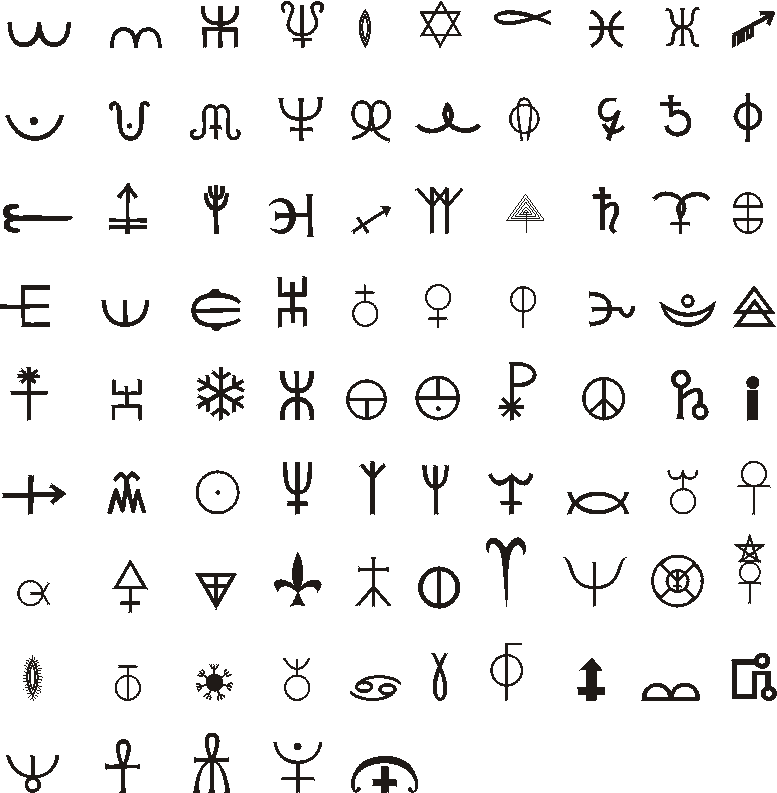
The first group consists of worldview symbols. They vividly express some idea or complex of ideas.
The second group consists of effect-producing symbols which, besides expressing an idea, are capable of exerting direct influence on objects and events.
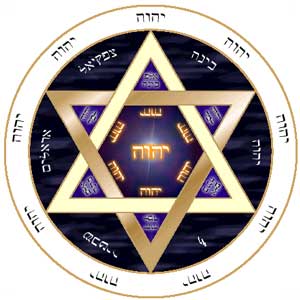
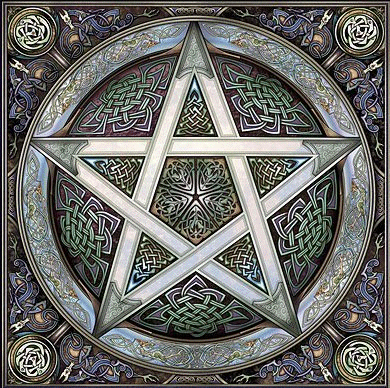
A classic example that helps to explain the difference between these two groups is the Signs of the Hexagram (Magen David) and the Pentagram.
The first sign is a symbol of the Macrocosm, the symbol of the union of Involution and Evolution, the Symbol of Matter’s striving toward Spirit and of Spirit’s striving to penetrate Matter. The vast symbolic field of the six-pointed star can be discussed at length; however, it is almost never used for direct magical purposes. Even when inscribed in the magic circle, the Hexagram serves as a testament to the magus’s authority, his knowledge of the laws of the world’s existence. Any effect from the use of such signs depends on the Power of the operator, on the operator’s understanding of the sign’s symbolic field.
The Pentagram, a Sign of the Microcosm, a symbol of its Free Will, likewise describes a fairly wide spectrum of ideas. At the same time, its mere depiction produces certain changes in the world: for example, it protects against evil spirits (when upright) or benevolent spirits (when inverted). Moreover, this effect can manifest even in the operator’s complete lack of understanding of the symbol’s meaning, and even when the practitioner clearly lacks their own power.
Among the symbols possessing Realizational Power one can also mention the Christian Cross (as distinct from the pagan equal-armed cross), the so-called Sigils (“seals” and “signatures” of spirits) and Runes.
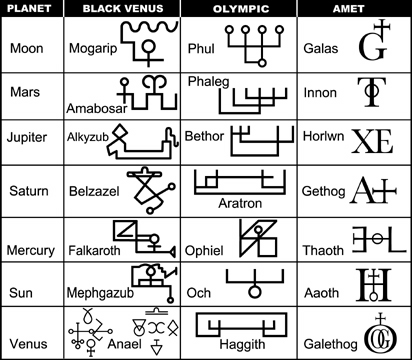
The effects arising from the inscribing of such signs can be explained in different ways. It is often said that these signs affect the operator’s unconscious, causing changes in it, which, naturally, are reflected in the surrounding world, which, of course, is a product of description.
Another way of explaining the action of Signs is through the Law of Sacrifice: any event is the consequence of some limitation. Just as the creation of the world came about through the Creator’s (or the Creators’) self-limitation, so the creation of an event requires some “sacrifice”. Mythology knows many such examples, from the creation of the world from the body of the slain Ymir to Christian Redemption at the price of Christ’s Sacrifice.
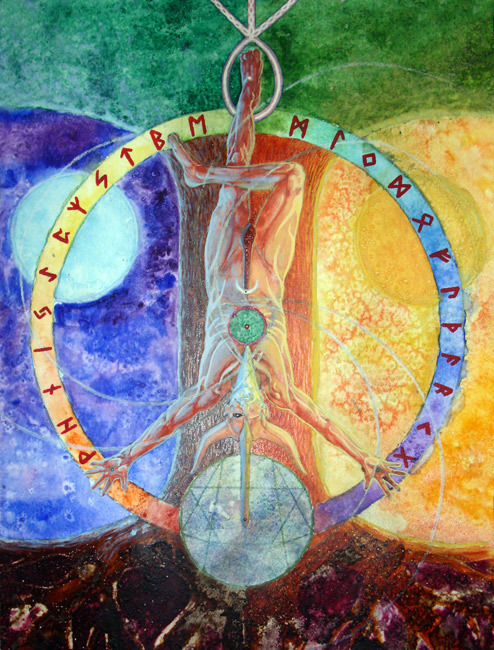
The Law of Sacrifice is not metaphysical but a universal law: any action requires, at a minimum, expenditure of power and other resources, usually other resources (tools, time, etc.).
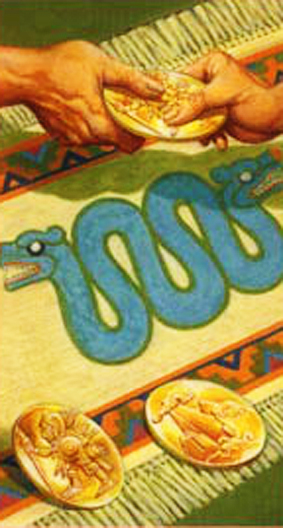
In this sense, Signs are considered “Sickles“, i.e., “money” that allows one to “buy” a certain event, phenomenon, or action. Whether by resonance with elements of the subconscious or with some “external” forces, such signs will buy results.
However, such “powerful signs” are heterogeneous as well. They can be divided, in turn, into the so-called Amulets and Talismans. Amulets draw external forces to the practitioner which he does not possess, harnessing currents inaccessible without the sign. Talismans, on the other hand, activate powers present within the operator, making them accessible rather than dormant.
It is clear that symbols which are amulets for some may be talismans for others.
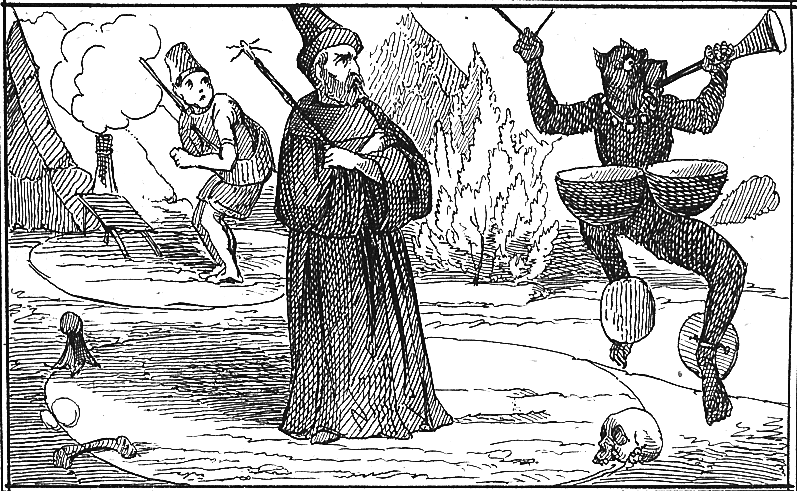
For example, the sigils of spirits may be amulets for a student of magic and talismans for an experienced magus. The same is true of Runes.
However, we repeat: regardless of one’s understanding of the sign’s symbolic field, regardless of whether a given sign is an amulet or a talisman for a given practitioner, when inscribed correctly such a sign will inevitably produce an effect.
It is also clear that a lack of understanding of the meaning of a symbol without realizational power will render it completely useless, whereas a failure to understand the meaning (and operation) of a Realizational symbol may lead to unforeseen or calamitous results.
Therefore it is no accident that Egil Skallagrimsson warned:
«Let no one cut the Runes
who does not understand them.
In unfamiliar signs
anyone may lose their way».
Understanding symbols and their creation or even mere inscription requires great power. Therefore the same sign may be understood differently and, accordingly, elicit different levels of awareness in people with different levels of power.
It turns out that realization signs have a huge drawback, as their “Power” acts independently of the Will of the operator, and their advantage lies only in the fact that they “pump” weak manifestations of Will/Consciousness …
By independence, it is understood that complete coincidence of two Wills (of the operator and the symbol, what stands behind it) is not essential, but only their coincidence in sign (necessary for activation) is important. The result is achieved (the nature of the symbols guarantees this), however, accuracy, and hence value, do not always correspond to expectations/value. Although it makes no sense to blame symbols for this; whoever takes up arms must be prepared to suffer from it.
Another negative aspect seems to me the apparent ease, accessibility of “magical” influence, which many tend to use for mercantile purposes, such as profit or settling scores …
In tradition, “sorcerers” are people who have received limited “supernatural” abilities, without deep/exact understanding of the process … while a Magician has reached heights of awareness and possesses unlimited powers for realizing his will from the height of his knowledge, and his actions are not considered supernatural, but lie entirely within his Nature.
…
Indeed, may he who does not understand not cut the Runes!
“Merits” and “drawbacks” are products of description. There is nothing inherently “good” or “bad”; it becomes so only in accordance with its use.
However, realization symbols can indeed spoil, which we often observe in reality: it is well known that most magicians died violent deaths – confident in their omnipotence and impunity, they lost their adequacy and self-control.
I’ve been interested in Snakes and Dragons for a long time. I am very intrigued by the image of a two-headed snake (with a head instead of a tail). Can you tell me what it might mean???
For many years, I have worn a bracelet shaped like that snake – as an amulet-talisman-protector… I don’t know what to call it. At the very beginning of wearing it, I realized that without it, I would find myself in awkward situations. Now I don’t know if it has any influence or not – I haven’t taken it off for a long time and haven’t compared my life with and without it…
There’s also the question that I have intuitively chosen snakes-dragons as talismans-amulettes-protectors a long time ago, suddenly and purely instinctively – I couldn’t even explain it to myself – I just liked them… But I can’t find any meaning for the two-headed snake (only a terrifying story about Ambisfen suggesting no hidden meaning). Is there any principled difference?
And finally… Can a bracelet, ring, etc., be a realization sign? (It’s clear about a pendant shaped like a pentagram – it can be.)
Thank you in advance)))
Probably, it is a variation of the Ouroboros. It most likely symbolizes the reversibility of the flow of power. As for the realization power – it doesn’t depend on the form (ring, pendant, laminate, etc.), but rather on the meaning and graphics of the symbol on it.
Why do you write that the Hexagram has no realization power in terms of directed action? The Hexagram is actively used in working with the forces of the Macrocosm – both in banishment and in summoning elemental and planetary forces. Or did I not understand everything correctly?
You understood correctly, but such use of the hexagram is a product of the ZZ; previously, it was only used as an additional element in constructing Magical circles.
“What is an amulet for a student is a talisman for a practitioner.” That is, in the practitioner, there remains a vectorial force that accumulates during the ritual and outside it as it “sleeps” (potential state) and which is actualized during the next ritual?
Hello, Enmerkar! Please tell me, in your opinion, what is the difference between pantacles and talismans (and amulets)? What general definition can be given to the concept of ‘pantacle’? Thank you!
A pantacle is a tool of magical realization aimed at facilitating the magician’s interaction with otherworldly beings and objects. In other words, a Pantacle is a sickle that buys the Gates, a kind of ‘universal key’ that opens the door between worlds. Unlike amulets and talismans, it does not just ‘buy’ the flow of Power, but guides the stream of the operator’s consciousness through the Veil between worlds.
One person, back in his youth, carved an inverted pentagram on his shoulder with a blade. Over time, the scar became almost unnoticeable, but when I began interacting with this person regarding a certain issue, the lines of the scar on his shoulder became more pronounced. After a few weeks, an inverted pentagram was prominently displayed on his shoulder, as if it had just been carved recently. At that time, I didn’t know what to think, but now I understand – a protection against good spirits has been activated in him… Thank you, I find answers in you.
Hello everyone! If there are those here who have been practicing magic for many years, I ask – does anyone want to take me on as a student (through the internet, of course)?
And yes, thank you for the information provided on this site, and in general, a huge THANK YOU to everyone!
Did the star used in the USSR work as a talisman?