Kolo of Veles: Opening the Gates
The Slavic magical tradition has preserved several special cyclical rituals — “Kola” — aimed at acquiring wisdom and power.
The first Kolo, from which any magical path begins, is the Kolo of Veles.
Let us begin with a definition: the Kolo of Veles is a cyclical ritual that allows a participant to open within themselves the possibility of accumulating Power.
Now let us try to unpack this definition — both as a whole and in its parts. We will proceed inductively, beginning with the words that compose it.
We have already understood that “Kolo” is the name of a cyclical ritual. Cyclicity here implies that at the ritual’s end the participant returns to a point coinciding with the starting point in two coordinates, but differing in the third. In other words, a Kolo is a fragment of a spiral that raises (or lowers) the participant along the axis of awareness.
The Kolo we are considering is dedicated to the god Veles.

In the Slavic tradition Veles is the god of world order, the Keeper of the Threshold, the God who upholds the integrity of the Cosmos and the separation of the worlds.
Thus Veles is the first keeper of manifestation, separating the primary categories — Chaos and Cosmos, Nav and Yav, Prav and Kriv.
Slavic mythological thought is, to a large extent, intuitive in essence, and therefore runic in form.
This is what the graphic Signs of Veles often seen in Slavic ornamentation symbolize:

These two pairs differ in form, which was determined by the material used for inscribing the signs: on stone it is easier to carve right angles, while on wood oblique angles following the grain are preferable. In each pair the first sign signifies the Principle of the Actor (in this case Veles), and the second — the Effect upon the outside observer (the human).
Since Veles is an ancient god who existed even before the manifestation of the world, events from His point of view unfolded as follows:

For our present discussion it is important only that Veles is the central point in the birth of world polarity, and hence his role as Keeper of the Threshold.
For an observer situated below the actors mentioned above, the picture appears differently (symmetrically):

And when projected into matter (that is, from the lower point):

This is how the fourfold division of the world arises (and the Kolo’s fourfold division is of the World cycle and the Kolo — the cyclical Ritual — for every Ritual mirrors the process of cosmogony).
The Sign of Veles describes the Threshold in all the richness of that concept. We have just considered the Threshold as the border between the creator and the created.
The Threshold can also be viewed as the boundary between creation and the created:

In this form the Sign of Veles depicts from an ontological point of view: Kin and that which is with it (Nature) are co-eternal and are divided by Veles’ threshold.
However, epistemologically — that is, for the knowing mind — the Creator is prior to the Created, and creativity is regarded as a dynamic process, as dynamic. Thus the world’s dynamic cycle, or vortex, appears.
Before moving on, let us examine a few more correspondences in the Sign of Veles:
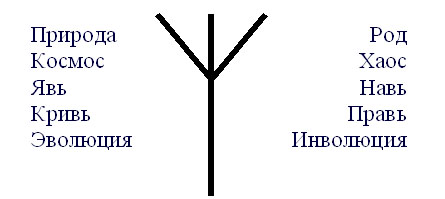
These series of correspondences lead us to an important conclusion: Veles is not only the power of binding but also the power of interconnection, because in each pair each member is connected to its counterpart.
Traditionally the path of evolution is associated with the Sun, and therefore with movement sunwise (clockwise), whereas involution is associated with the Earth and movement against-sunwise (counterclockwise).
From the point of view of the Sign of Veles these concepts are symbolized by the two half-swastikas that arise when this sign is activated:

Because Veles is the god of the boundary, such activation — and therefore the crossing of that boundary — is perceived negatively as a disturbance of order. In our world such crossings are called death.
Moreover, the first crossing (sunwise) is experienced as the transition from Yav into Nav, physical death, while the second crossing (against-sunwise) is the transition from Kriv into Prav, magical death. The first crossing is the Kolo of Veles in the sense of the cycle of life (and therefore Veles is the father of life), and the second crossing constitutes the essence of the Kolo of Veles as a ritual.
Thus we have arrived at the essence of the Ritual Kolo of Veles.
As we have already understood, at the core of this ritual lies the notion that on the level of Yav the corresponding Kriv typically dominates, yet a transition from Kriv into Prav is possible:
 Therefore the task of the Kolo of Veles is to shift the mind’s perspective from viewing the world from Kriv (that is, human perception) to perceiving it from Prav’s standpoint (that is, magical, sorcerous perception). It is precisely this that paves the way to accumulating power and makes the Kolo of Veles the initial necessary step on the path of sorcery.
It should be noted that the value of the Kolo of Veles lies not only in the fact that it brings about such a transition, but also in the fact that this transition is one-way, for Veles, as lord of the boundary, does not favor repeated crossings of the Threshold; therefore the effect of the Kolo is usually long-term.
As we have already mentioned, in its application to matter the Sign of Veles projects into the quaternary sign of Dazhbog — the cross.
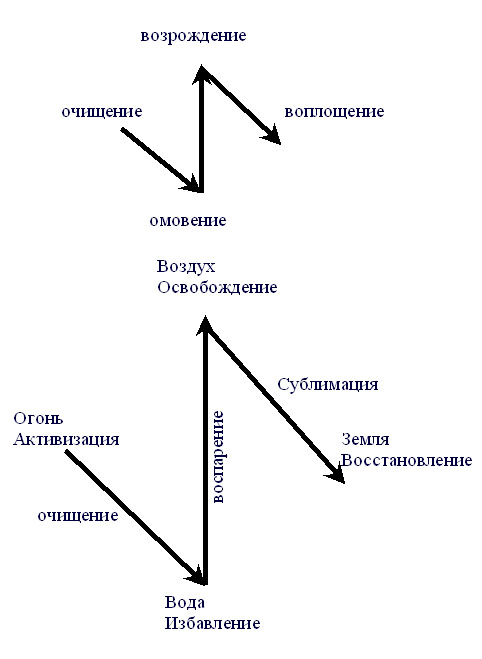
Therefore to each point on the path of transition in the ritual certain principles correspond, symbolized by the principles (elements), as well as the cardinal directions:
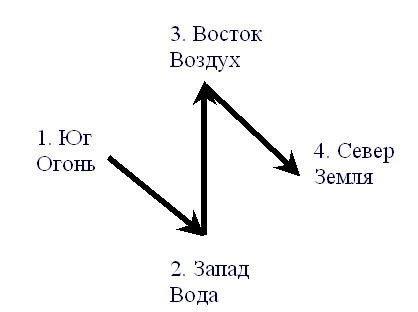
Note that the initial (1) and final (4) points do not differ in this ritual in the vertical coordinate, but they do differ in the horizontal; it is for this reason that the Kolo of Veles in itself does not bestow power but is a necessary condition for its accumulation, because it shifts minds from the realm of wasteful expenditure (Kriv) into the realm of effective realization (Prav).
Also note that it is precisely the introduction into the ossified Kriv principle of the mobile principle of fire that enables one successfully to overcome its shackles, and that establishing in the mobile principle of Prav the firmness of earth allows the result to be secured.
And finally, for the understanding of the theoretical foundations of the Kolo of Veles (its practical realization, of course, must not remain only words), we present two more series of correspondences:
Thank you very much for the informative article. I was interested in the life of the Slavs and came across your site, thus learning a lot of interesting and informative things. Thanks again.
Dear Enmerkar, can you tell me why in the latest alignment the air-liberation?
The Element of Air is the principle of minimum restrictions: https://enmerkar.com/en/myth/air-principle-of-mobility
I can’t grasp why the north is to the right of the east… like in a mirror.
In magical schemes, it is often customary to use a “mirror” image – it reflects a way of perceiving transcendent reality.
The last scheme: is restoration death?
If the Circle is performed not in a ritual sense, but as part of a global process, then death occurs in the west.
Why is the essence of this ritual reflected in the counterclockwise half-swastika? As far as I understand, such a symbol means regression regarding many points of view and, if we follow the logic, this ritual would be better reflected in a symbol that means progress?
The transition of the counter-sun is not necessarily regression, that’s how the Earth moves – it does not regress. The whole question is in the point of view. Moreover, if one uses the ‘right’ half-swastika, then the entire transition of the Circle will occur from right to left, which, as stated in the article, means a transition from life to death.
Thank you very much for confirming and expanding with this article the information that I already knew.
Could you please tell me if this transition from Krivi to Pravi through elements relates to the so-called ‘Elementary Gates of Power’, or are you not aware of such? (I need confirmation of the information I have gathered piecemeal, please help 🙂
Good day. Thank you for the article. How to conduct the ritual itself?
These cycles are all around, outside and inside: in the changing moons and seasons, in the life of the body, for instance—in breathing. Cells purify themselves, shedding the spent—exhale-inhale—simultaneously accumulating fresh and working, realizing their purpose. In the snake’s shedding and in the changing personality. So, Numen, something does die 🙂
If you remove emotions and the desire to be right, then Numen speaks of the process of including new elements into consciousness. In my opinion, this differs from a mere collar. At the very least, by reading imprints several times, I can say that it didn’t resemble the transformation of the entire system with death. It was just shaken for some time, and then a new quality would appear that permeates the entire system. This speaks to either two processes or one as a part of another. I’d love to get to the bottom of this; that prize isn’t comparable to the sensation of one’s own correctness and all other similar feelings. I would like to know)
No matter how right Numen or anyone else might be, my sensations are the most right for me 🙂 at this moment in time. Tomorrow they may change, and again they will be the most right, exclusively for me. I feel that dying is a part of the transformation process. Not the entire system dies but the configuration that exists within it at that moment. It’s not a question of what to call it—whether it’s dying or not. Did yesterday die or simply pass? And the phrase with Numen is an awkward thanks to him for the comment that drew my attention to the topic and sparked new sensations.
Blog readers or participants in expeditions explain: The last drawing. Starting point 1. (south) movement to the intermediate point 2. (west). The question – How can you move from south to west “against the sun” if you can only physically move from south to west “with the sun”?
Stand on the other side of the mirror. Practically, this means to draw on transparent paper and look at it from the back side or to place a mirror next to the drawing and look at its (the drawing’s) reflection in that mirror.
It is clear why the south is fire because it is warmer on the equator than in the northern hemisphere, and the sun tilts to the south in winter, why water is in the west; it is unclear that water is present all around the world. Air is in the east, possibly because the sun is supposed to rise tomorrow, the earth is in the west because the sun dies there; thus, water in the north definitely exists in the form of ice.
Good evening. I read your blog. There is no information about Kolo Velesa on the internet. Is it possible to find the practice? There is no teacher, and there will never be. Truth always lives outside of authoritative dogmas and opinions, and I would like to figure it all out myself. Please respond to my email if it’s not too much trouble.
I wonder if beauty will save the world or not? Maybe everything? Maybe we are already too late forever?
Hello! Please tell me if the graphic resemblance of the Transition sign to the rune Eiwaz is just resemblance or is there a semantic connection between them?
There is indeed a connection since Eiwaz is the Rune of connection and transition.
It seems this is a desire for the hopeless. Is it really possible to improve oneself?
*the second transition (against the sun) – is like a transition from Krivi to Prav, i.e., magical death. Please tell me about this. What if it is the other way around? Left-handed people always write in a circle counterclockwise. And such a movement occurs in nature, in the psyche of a person. What does this magical death give to a person? If there are materials on the site – provide links, there are a lot of articles, I may have missed some. In what situations is counterclockwise movement necessary?
Clockwise is the movement of the Sun; counterclockwise is the movement of the Earth. And here it is not about right-handers and left-handers, rather, in that the Tradition was formed in the Northern Hemisphere of the planet. ‘Magical death’ is the rejection of the old, destructive shell of consciousness and its transformation into a more constructive form.