
Stikhials — Lesser Gods
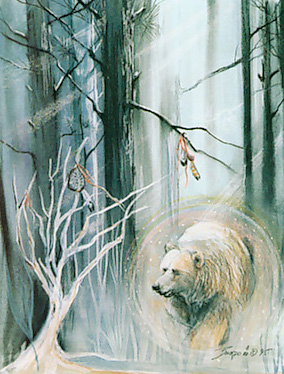
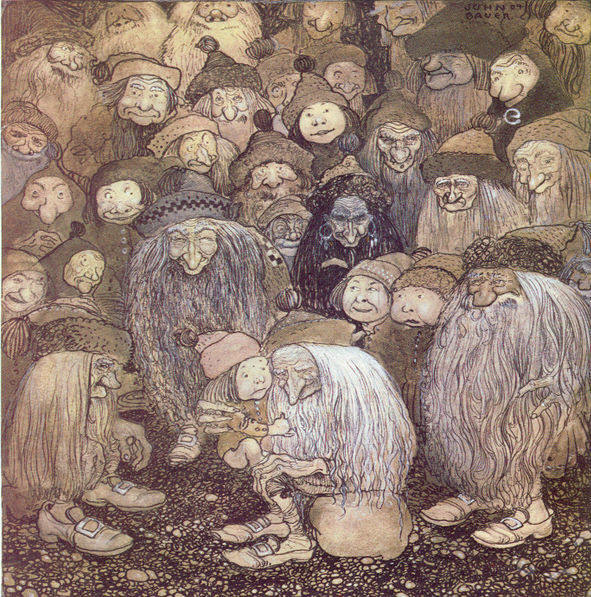
In our discussion of the Vanir we already mentioned that this clan of gods animates nature. Every forest and mountain, river and valley, every ancient tree has its own guardian god from the Vanir. All elements of nature are inhabited by spirits — “masters“, which, following D. Andreyev, are commonly called “Stikhials“. Among them are leshies, mountain spirits, water spirits, fire spirits, and so on. There are also domestic “masters” — domovye, banniki, ovinniki, gumeniki, mel’nichniki… Each has its own domain, but their cares and sorrows are similar. Unlike the principal deities, whom few people ever saw, the lesser stikhials revealed themselves to humans quite often. The ancients lived surrounded by such lesser gods and met them everywhere — in the forest and in the field, on the river and the sea.
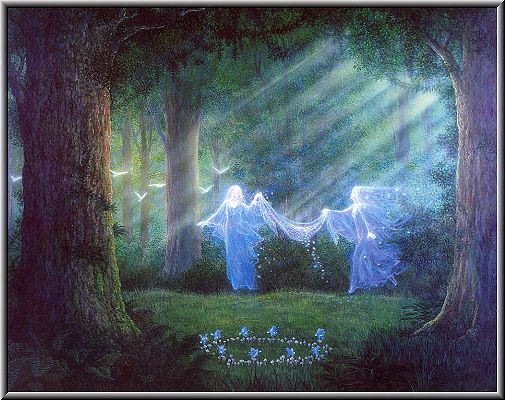
The Slavs stood in especially close communication with the spirits of nature, which is why Slavic folk mythology preserved numerous descriptions of the character and peculiarities of various Stikhials. The ancient Slavs did not set themselves apart from nature; they perceived themselves as an organic continuation of its “body,” “seeing” and “feeling” it from within.
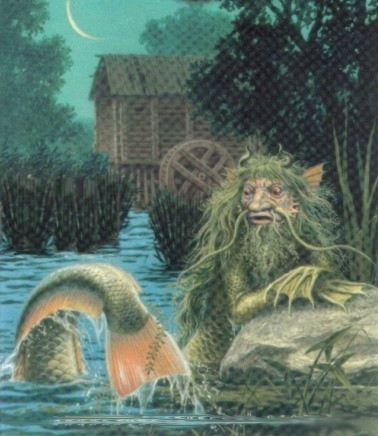
Stikhials dwelling in the water principle were called Vodyanye. The Vodyanoy — master of the water principle — rules the seas, rivers, and lakes and is the lord and patron of fish. Proverbs about him say: “Grandfather Vodyanoy is the chief over the water“; “He takes dues from every new mill“. According to storytellers, the Vodyanoy is taller than an ordinary person. Most often he appears as an old man, frequently bearded and shaggy. The Vodyanoy is skilled in shapeshifting. He can take the form of a black dog, but more often appears as a fish, sometimes even a winged one. In Perm Governorate it was said that the Vodyanoy can sometimes appear translucent, as if made of ice, naked, with skin the color of a burbot’s hide. He is generally hostile to humans: he frightens and drowns swimmers, scatters and lets fish escape from nets, and destroys dams. Even where vodyanye seem to have grown accustomed to people, they can sometimes get so unruly that they frighten a person to death or even drown him.
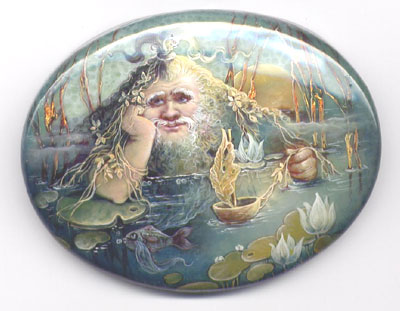
According to a number of traditions, the Vodyanoy can appear to people not only as an old man, but also as a naked boy. In Vologda Governorate, for example, the Vodyanoy is in no way imagined as an old man. He is “a peasant, very broad-shouldered with thin legs; he has small horns, a body covered with scales, a tail three-quarters of a sazhen long, fingers on hands and feet very long with curved, strong nails, and webbing between the fingers.” He leaps straight into the nets set by fishermen, and afterward an enormous, as if burned-through, hole appears in that spot. Sometimes his capacity for rejuvenation was explained by his close connection with the moon: at the new moon he is young, and at the full moon he is old. In the book Ancient Religion of the Slavs G. Glinka describes the Vodyanoy and his habits: «Water spirits, or grandfathers, live in the deep places of rivers, where they have splendid houses. They carry off swimmers from those places, especially boys, whom they accustom to live in their houses, and these later take the place of those grandfathers». The Vodyanoy carries off those who bathe after sunset or at noon or at the dead of night.
Fishermen also avoided night fishing with lights, believing that the Vodyanoy disliked it and would wreak cruel vengeance on those who disturbed his peace. It was believed that the Vodyanoy seizes those who, before bathing, forgot to make the sign of the cross over themselves, and also those who do not wear crosses, forget them at home, or remove them before bathing. Among the Eastern Slavs, and also among Czechs, Slovenians, and Lusatian Serbs, there are known vodyanitsy — female water spirits; in the North they were called vodyanikhi. The Vodyanoy is a patron of millers and beekeepers, who sacrifice fish, tobacco, honeycombs, and even the heads of roosters or rams, various dead animals and sometimes live horses. Gifts were brought either in spring or autumn, and always when building a mill or a dam. Libations to the Vodyanoy were also performed. There are many accounts of encounters with a water spirit in the form of a woman combing long hair. Women vodyanitsy were called by the same names as male water spirits, but they were not recognized as masters of the water principle. Seeing a female vodyanitsa was considered an ill omen, although nothing bad might actually happen.
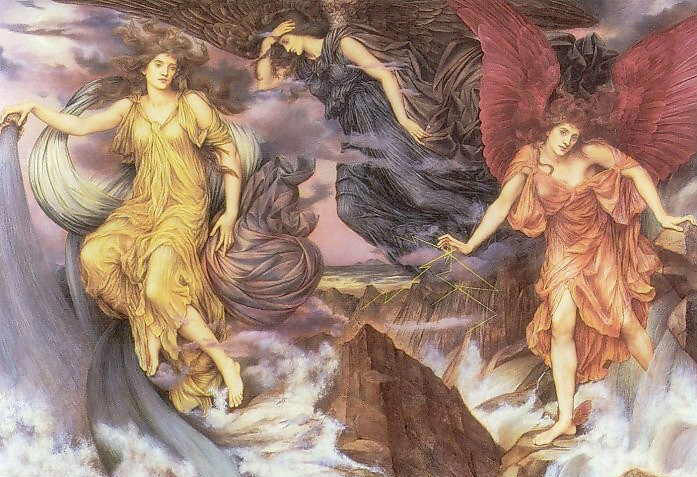
Vily in Slavic folklore are lesser female deities, patrons of moisture, primarily the atmospheric moisture that sustains life. Vily are forest, field, mountain, water, or air maidens who may behave either friendly or hostile toward a person depending on his conduct. Vily possess the power to “lock” waters. The name Vily (from the verb “vity” — to twist) spin fleeces of cloud and draw golden threads of lightning from them. As mythical bestowers of life, the Vily are often mentioned alongside the rozhanitsy and, above all, with Mokosh: «... and among other peoples they pray to their accursed gods Perun, Hors and Mokosh and to the Vily», wrote the author of the “Sermon on Idols”. Vily are depicted as prophetic spinners of life’s thread. They are also called likhoplesi (that is, weavers of misfortune — the woes of life and death). An enraged Vila is capable of killing with a glance, like a basilisk.
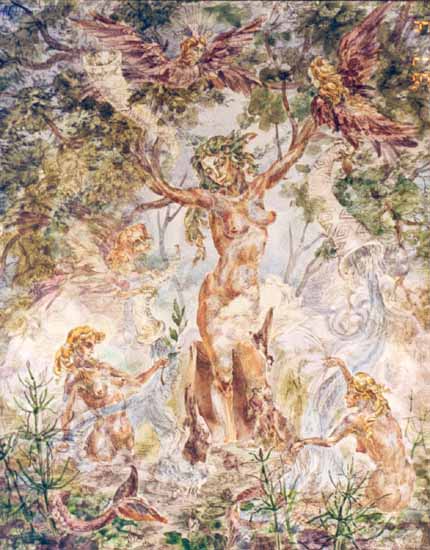
In “The Word of a Certain Christ-lover” the exact number of Vily is even given: «A Christian could not tolerate Christians who live in double faith, believing in Perun and Hors, and in Mokosh, and in Simargl, and in the Vily, whose number is thirty sisters. For the ignorant say: ‘They all are thought to be goddesses,’ and so they make offerings to them and slaughter chickens for them.».
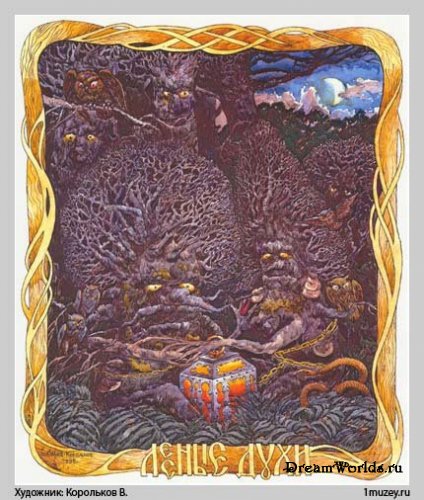
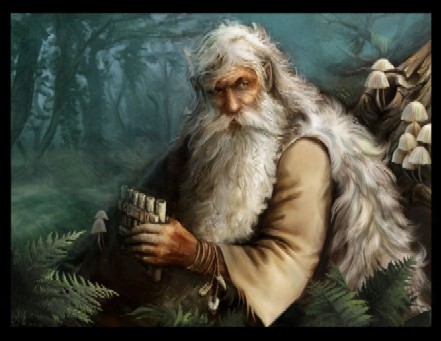
To the Lesovik, patron of the hunt, the first kill was left on a stump. Many peasants believed that each forest had its own Lesovik. He often appeared accompanied by a pack of wolves or drove animals and birds from one place to another. It was believed that he could lead a lost traveler out of the woods, but if angered he could instead lead a person into the thicket and destroy him. In different parts of Russia he is called by various names: leshak, lyad, leshy, garkun, etc. As a rule the Lesovik appears in a human but unusual form. Above all, he has the ability to change his height depending on what surrounds him: in a forest he stretches up to the tallest trees, in a shrubbery he is no taller than the smallest bush. In the nineteenth century the leshy was described as an old man in white clothing, girded with a red sash or without a belt at all. The most vivid sign that the old man you meet belongs to another world is that the left flap of his caftan is buttoned over the right, his shoes are on the wrong feet, and when he sits he throws his left leg over his right.
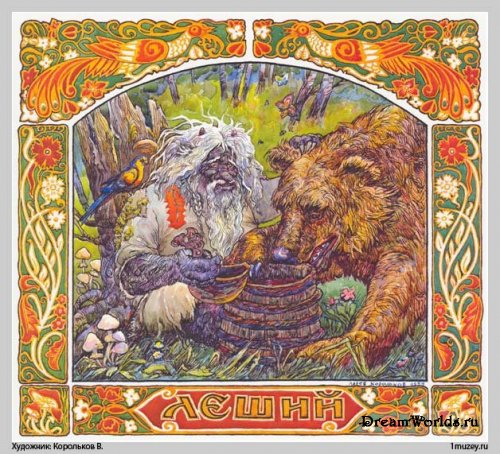
More often the master of the forest was imagined dressed in animal hide (dlaka); sometimes he bore animal attributes: horns, hooves, and so on. It is frequently added that the leshy has wide, rolling green eyes, only one ear, is mute but vociferous: he sings without words and stamps his feet in time, clapping his hands. In the Russian North the Lesovik is simply called “lesom.” “By appearance the forest is like a man, only his blood is dark, not light as in humans, and therefore he is called bluish in form.”
The Leshy can walk around an unwary person, and that person will long wander inside the enchanted circle, unable to step across the closed line. But the Leshy, like all living nature, knows how to repay good for good. All he asks is that a person, entering the forest, respect the forest laws and do no harm to the woods. The forest spirit-master acts as a sort of guarantor of hunters’ observance of the rules of hunting ethics, punishing those guilty of violations by depriving them of success in the hunt.
A story was recorded of how, before a forest fire, the leshy, blowing a horn, drove the animals out. “And bears and wolves, foxes and hares, squirrels, elks, goats fell out of the forest… Every forest creature went with its mate and did not mix with others, and paid no attention to people at all. And after the beasts came ‘he’ himself, with a whip over his shoulder and a horn in his hands. And by his stature he would be larger than a bell-tower.”
It is often told that leshies take part in battles for the homeland as ordinary warriors. Thus, one of the Vladimir leshies fought the Tatar-Mongols and even lost an eye in battle, and his son participated in the Russo-Turkish wars. In 1943, according to storytellers from Sosnovoye Solontso, the local Lesovik from Samarskaya Luka perished in the war. Leshies, like humans, have two sexes. Tales of the forest hostess occur far less often than those of the master. She is called by different names in different regions: leshachikha, lesanya, leshevitsa, leshovka. In the nineteenth century there was a belief that “leshies at the onset of winter (on Erofey, October 4) fall through the earth, disappearing for the entire winter, and in spring they again spring out of the ground. Parting from the forest, they rave, break trees and drive all the animals into their burrows: at this time peasants are afraid to go into the woods“. In winter the leshies in the forest were replaced by Perun’s assistants, who were even stricter with people, the kalinniki (from the word “kalit’”): Morozko, Treskunets, Karachun.
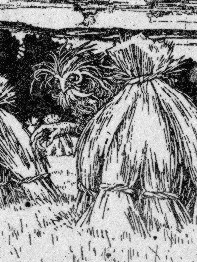
In the fields, in tall grass or high ears of grain, live the field spirits. Poleviki protect grain fields from calamity, the evil eye, and harmful forces. Their appearance varies by region: sometimes they are in white, sometimes black, with differently colored eyes and grass for hair. Usually they appear at noon. Poleviki most often take the form of small men who live in the wheat and possess human speech and the ability to strike down reapers. Peasants of Tula Governorate believed that the hairy poleviki or meadow-spirits live underground in burrows but emerge at noon and just before sunset. At these times they are dangerous and can “bring sickness, fever upon a person.” During harvest they run and hide in the ears that remain uncut in the field. In the Russian North the Polevik is a white man, often whistling or blowing and thereby raising wind, or a young man with long legs, running fast, having little horns and a tail with a tuft at the end that he uses to stir up dust to hide himself. His body is covered in fire-colored fur and therefore he appears like a spark when running and is hard to see (visible on hot summer days and sometimes on moonlit nights). In northern Belarus each Polevik had his own field — the fields and meadows of one or several neighboring villages not separated by forest or water.
Such a view of nature as a place where life thrives on and beneath the surface but also beneath it fundamentally alters one’s attitude toward nature and its manifestations. It does not allow a consumer attitude toward the environment as merely a source of “material goods”; it fosters responsibility and breadth of vision, and protects against anger and selfishness. The habit of seeing nature as the dwelling place of various beings occupying different planes and hierarchies shows a human’s place in the Great Flow of Power as a full-fledged participant, not a consumer, of that Flow.
The blog is awesome, I read it and can’t tear myself away for several days now, I have been looking for something like this for a long time, very broad coverage of information combined with depth of consideration. To be honest, I couldn’t understand how to relate to such phenomena as water spirits and how to protect oneself from their harmful acts. They seem to be both guardians of nature with a sufficiently high level of consciousness close to human levels, and on the other hand, unfriendly and cunning killers that drown living beings. Do they all have such tendencies towards drowning, or do their characters differ just like people? Or is it something like a predator that should be avoided or fed to avoid confrontation? I am also interested to know why Christianity records all of this in the section of iniquity and why, according to stories, Christian prayer and exorcism seem to work against these beings? (In the story it was described that, according to the belief, those who did not wear a cross were less protected from the enticements of the water spirit) Overall, I am generally interested in the question of the conflict between Christian entities from the subtle plane and the so-called pagan gods/spirits. Are they analogies that replace each other, or are they different beings that, for a number of reasons, cannot coexist? I am also always interested in the question of why sacrifices are made? Is it about the energy of the slain victim and the aromas from the food that a particular entity feeds on? How is the very mechanics arranged and why was it done and is done in various forms in all the religions of the world? Starting from the offering of people and animals, ending with the offerings of grains, fruits, etc. Do you have articles covering these questions? Please provide a link or at least approximate titles. Thank you very much in advance.
‘Water spirits,’ ‘leshy’ are not elemental beings, but rather elementals, generated by the very nature of that or those phenomena. Their relationship to humans is dictated by the relationship of humans to nature, as well as their past (including forgotten) actions. So if someone has harmed (even unconsciously) nature in the past, they will receive a ‘strike’ from such elementals completely automatically, not because they are evil or unfriendly, but simply due to cause-and-effect reaction. It is precisely to ‘smooth out’ such a response, to balance the inflicted harm, that sacrifices were made.