
Cromlechs – The Power of the Sun on Earth
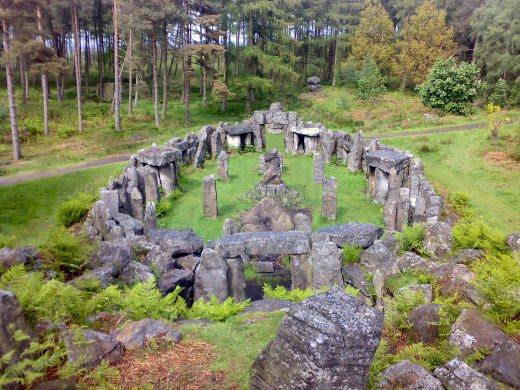
In Russian-language literature “Cromlechs” usually refer to megalithic stone circles. At the same time, the word “cromlech” itself comes from the Celtic “crwm” (vaulted) and “llech” (stone slab). This originally referred to dolmen-like structures. Therefore, in Wales and in parts of Britain, cromlechs were called dolmens in Russian literature. The ringed stone structures in the English-language tradition are called “stone circles.” The same sense is carried by the term “henge.” However, since it has become customary in Russian to call stone circles “Cromlechs,” we will follow that usage.
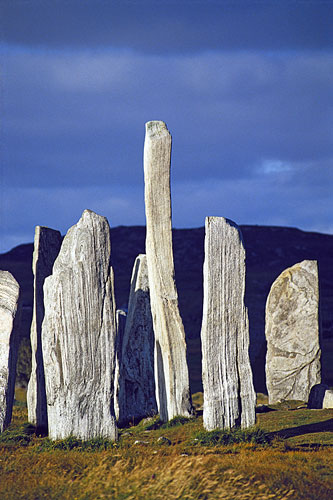
The stones that make up a cromlech can be elongated, like menhirs, or irregular boulders. Sometimes cromlechs have a more complex construction — their constituent stones may be topped in pairs or groups of three by horizontal slabs, forming a kind of roof. Stone is not the only material used. Thus, in Norfolk a wooden cromlech was found in quicksand.
All researchers agree that cromlechs are associated with the sun. Some consider them sanctuaries, others astronomical observatories. However, many cromlechs are located in far-from-sunny locations, in dense forests and lowlands. This largely excludes the observatory interpretation and casts doubt on an exclusively solar interpretation. A menhir or a hearth was usually placed at the center of a cromlech. Thus, a yoni-lingam symbol was formed, a symbol of the union of the male and female principles (circle + menhir). All this indicates that cromlechs were associated more with the Mother than with the Father, and specifically to her fertile aspect. That is, the cromlech denoted the mother’s face turned toward the father, receiving his power. Another confirmation of the “maternal” meaning of cromlechs is that burials are often found in them, or some cromlechs were built around barrows. As mentioned, both birth and death are the prerogatives of the Great Mother.
However, the solar paternal aspect is also clearly present. Not only their cyclical construction and clear astronomical correspondences (for example, often twelve stones), but also their power testifies to this. For example, in Crimea, among the menhirs, one finds sawn antlers or whole deer skeletons — an animal associated with the Sun across many cultures.
Thus, a cromlech marks a site where the forces of Earth and Sun, Mother and Father, unite, interpenetrate, and complement each other. This interpenetration, regarded as the source of life, made cromlechs centers of ancestor worship. The central menhir, the “Ancestral Stone,” in fact symbolized the clan or tribe as a unit of life. Accordingly, it embodied all the past and future of the tribe; it was both a dwelling for ancestral spirits and a source of strength for new births. Sacrifices offered in cromlechs were mainly aimed at sustaining clan life.
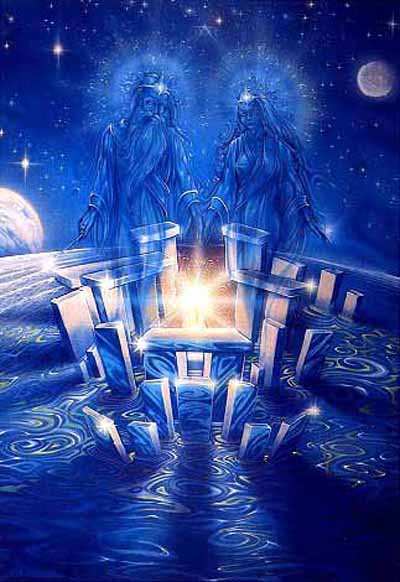
It should therefore be noted that the power of cromlechs is always aimed at ensuring the continuity of life; it is collective rather than individual. A person entering a henge-type structure for the first time experiences peculiar sensations. Visitors report that their pulse changes and their senses sharpen: they begin to see more vividly and more deeply; their emotions stabilize; daily worries recede and horizons broaden, as if someone guides their mind. All this is explained by cromlechs’ clan power.
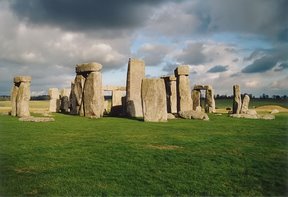
Cromlechs are found almost everywhere: in Europe, Asia, and even Australia. They are especially numerous in the Caucasus, the British Isles, and in Brittany, France. The best-known cromlech is Stonehenge. Avebury Henge is less famous than Stonehenge, although it surpasses it in size and structure. Its diameter is over a quarter of a mile, made of boulders up to 90 tons. The stones of Avebury rank among the largest megaliths ever erected — 60 to 90 tons, almost twice as heavy as the largest stones at Stonehenge.
Cromlechs are also numerous in Crimea. In Crimea, the largest cromlech lies beneath the Simferopol reservoir waters in the area of the former Vorontsov Grove near Simferopol. As described, “around a 12-meter circle, majestic vertical menhirs rise.”
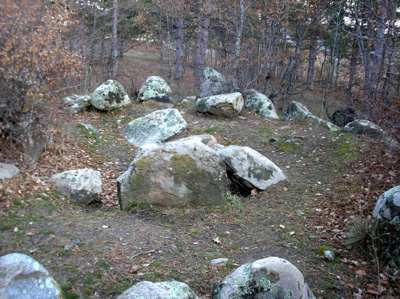
No less famous is the cromlech in Alushta. This cromlech was likely erected in the 3rd millennium BCE and is contemporary with England’s Stonehenge. It was first described in 1886 by V. F. Miller. In 1886, V. F. Miller excavated a small barrow. During the excavations, a stone circle was discovered with a stone burial box in the center. Presumably a chief’s burial, 5th–6th centuries BCE. Remains of bones, pottery, and evidence of a memorial feast were found. “It appears as a low barrow, about nine arshins in diameter, surrounded at the base by a regular ring of enormous stones set on edge — 29 stones from 1.5 to 2 arshins high. The interior of the ring is strewn with small stones, appearing almost paved. In the middle of the circle lies a mound of large stones; one of which is a two-arshin column, stands on the east side a sazhen away. The area around the monument is strewn with stones; two form a west entrance.” Currently, the middle circle of 24 and inner square of 12 are best preserved. Of the “outer” circle, only two stones have survived (there may originally have been 48). Many similar cromlechs exist in Crimea, including one west of Alushta in the mountains and another near Barabanovka village in Simferopol district.
interesting. thank you