
The Three Heads of Asmodeus
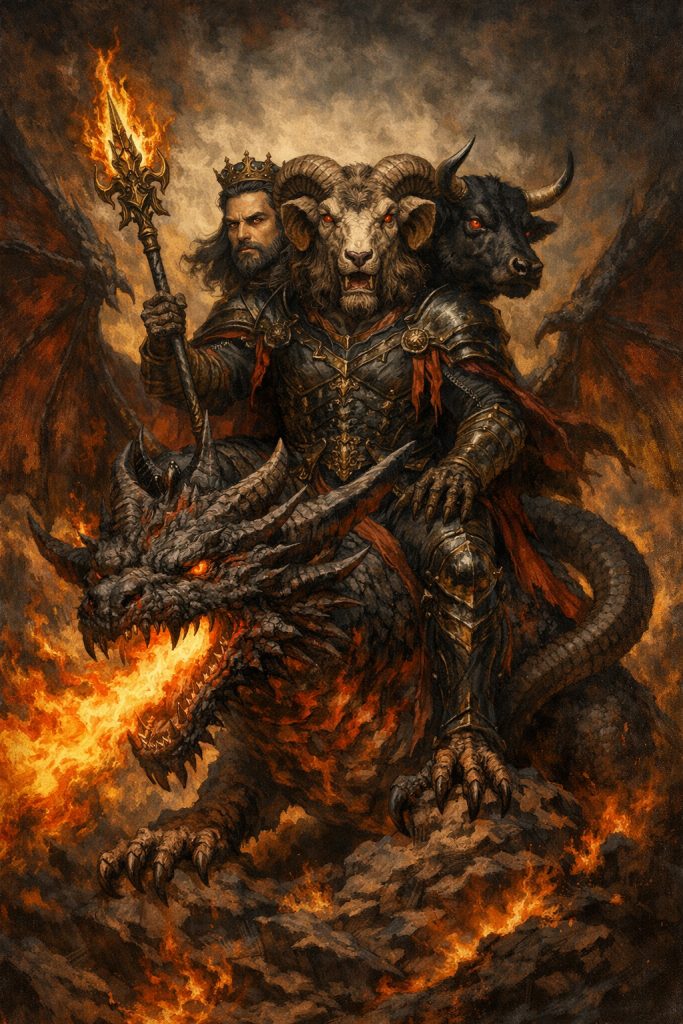
We have often discussed the critical importance of the images in which an entity appears, its attributes, and manifestations for understanding its nature and character. This is why “Lemegeton” and other grimoires devote significant attention to the external appearance of demons. Every detail of this appearance serves as a specific indicator of a particular property of a demonic matrix and vortex.
The animal or object on which a demon appears during a ritual signifies the element of nature or psyche over which the demon holds dominion, and the demon’s form expresses the essence of its activity. Its manifestation unfolds in three stages: 1) abstract, where presence is perceived through smell, sounds, or lights; 2) theriomorphic, where an animal form emerges, reflective of passions and instincts; 3) anthropomorphic, relevant as the aspect capable of interacting with humans.
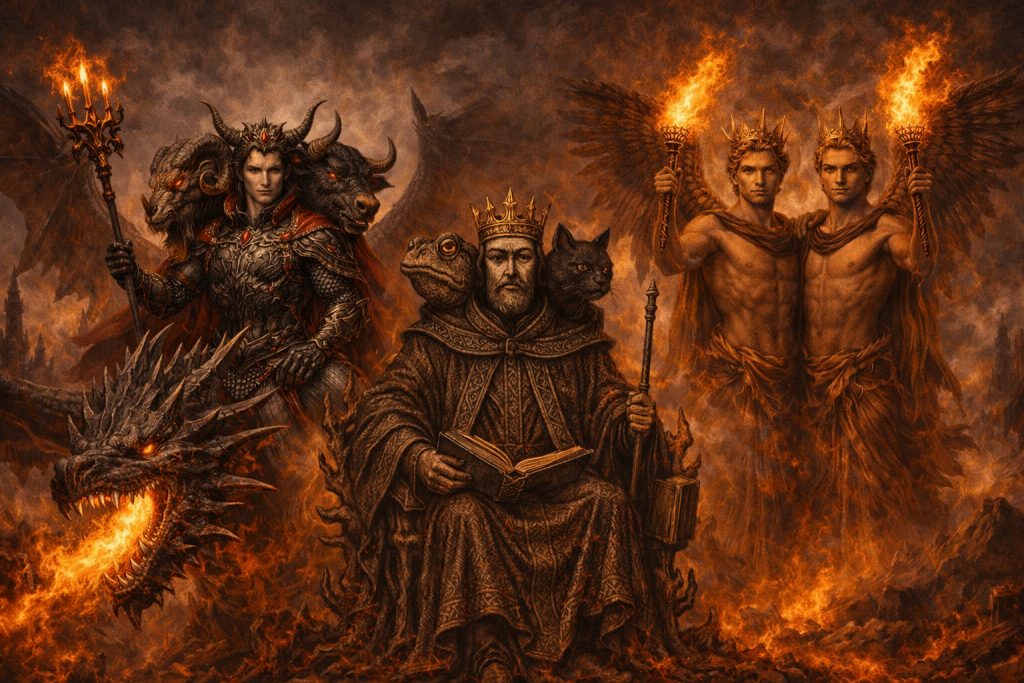
“Many-faced” entities, possessing multiple levels of manifestation, demand special attention. Often, discussions of a demon address only one of its faces, neglecting others, thereby missing essential aspects of its influence.
Consider the three supreme Kings of sin – Baal, Belial, and Asmodeus – appearing in three-faced forms, symbolizing their activity across mind, feeling, and will. Too often, the complexity of these manifestations is underestimated. Baal appears with the faces of a man (will), a cat (feelings), and a toad (mind), yet manifests as a spider paralyzing motion. Belial’s two human faces (two angels) express his power of unity through opposition, balanced by the dragon’s rage. Asmodeus shows a man, a bull, and a ram, seated on a dragon, symbolizing impulsivity, and his nuanced ability to manipulate elemental flows of sensibility and consciousness. Notice Asmodeus’ goose feet, echoing Baal’s amphibious toad, sometimes rooster legs symbolizing sensual dominance and moral ambiguity, and his serpentine tail, indicating deceptive wisdom.
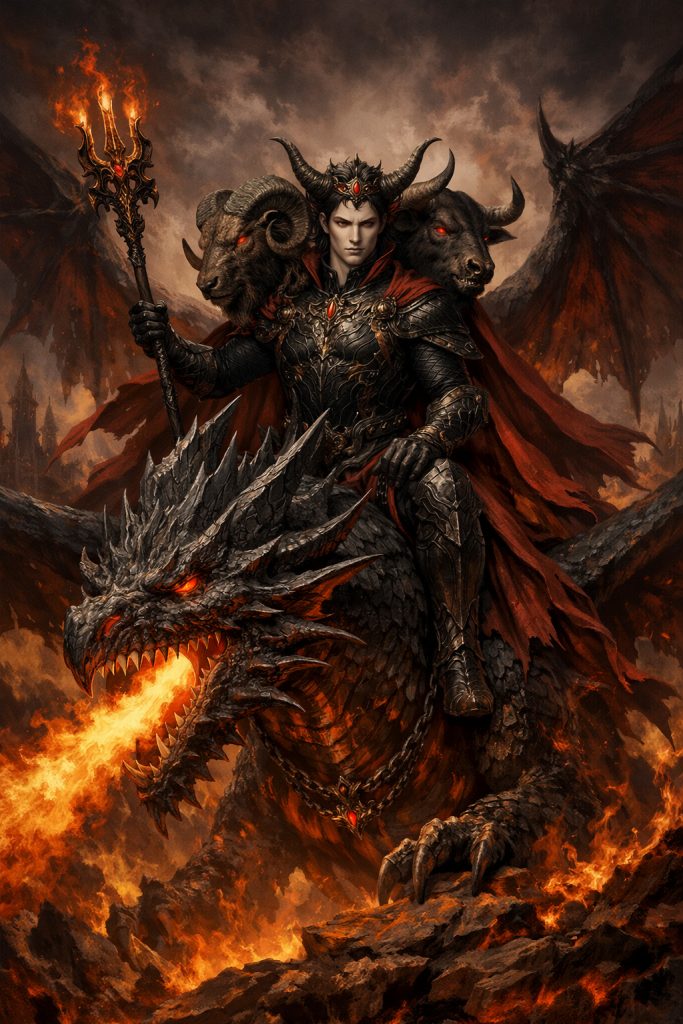
Asmodeus, three-faced, reigns over the conversion of attraction into greed. The ram signifies appropriation in instincts and bodily urges, the bull in accumulation and retention of information, and the human in logic and justification, turning desire into calculated exchange.
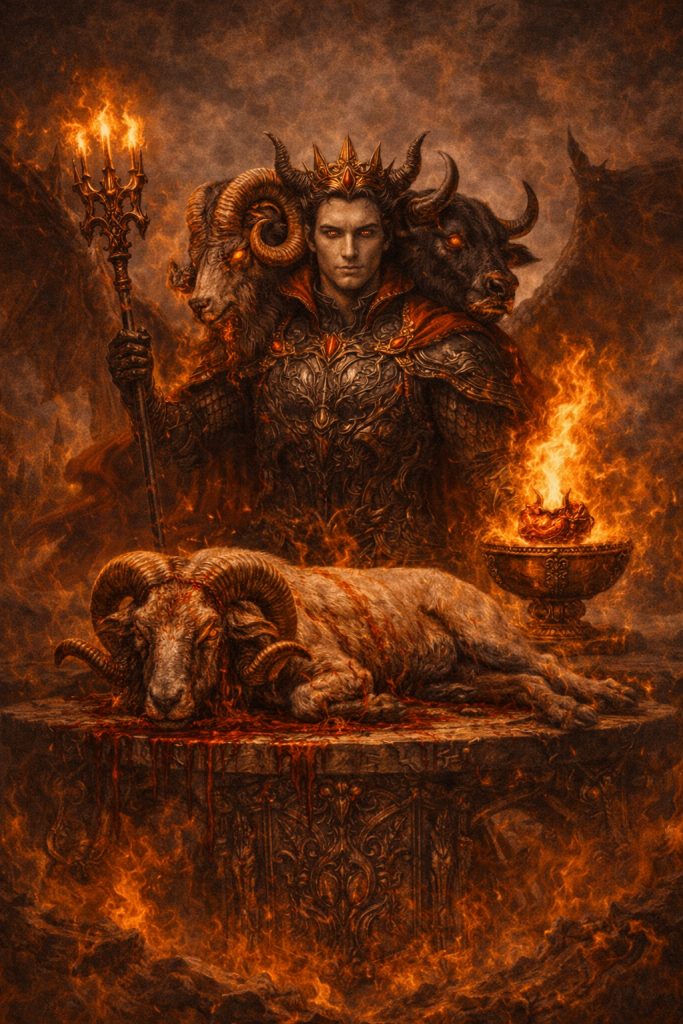
Descriptions typically ascribe to Asmodeus a sensory-emotional nature, labeling him a “demon of lust” in the broadest terms, focusing on the “Ram” face. The ram, symbolizing unbridled desire, represents the “familiar” guise of the Cold-Hearted King. The “sacrifice of the ram” was an ancient rite of submitting one’s passion to the Higher nature, with managing instinctual and sensual aspects being humankind’s primary challenge until recent times. Now, however, increased Arhontaya activity reshapes the field of psyche destructors: from uncontrolled passions to psychic asthenia and lack of inner fire.
Throughout history, Astaroth‘s role has grown – a demon without royal dignity who has become a key leader in the civilized world.
This does not mean the Kings have receded; such a view underestimates them. Though Asmodeus’ reign over sexuality’s flame seems diminished to mere soot, his dominion remains undiminished; only his dominant face has transformed. Asmodeus now manifests as the Bull of Knowledge, a world where greed translates into hyperconsumption of external stimuli. The Ram no longer represents primal lust but becomes the embodiment of market and content, arousal sans release, and false meetings. Relationships grow not in freedom, but in emptiness: the body reacts, the heart remains silent, and will deteriorates. Asmodeus adapts perfectly to the Archontic economy, leveraging it for the Realm of Avarice. When internal warmth wanes, it’s compensated with an external flood of activity — endless content. His dragon, no longer a creature of instinct and passion, becomes a medium of the modern environment: interfaces, feeds, notifications — a whirlwind as impassioned as the crucible of emotion. Thus, Asmodeus rules now when one ceases to discern breakdown, self-imposed and external. Testosterone, once his main tool, is now replaced by dopamine. Modern people find it difficult to believe in love, easier to succumb to stimuli, technology, surrogates that preclude risk of genuine engagement.
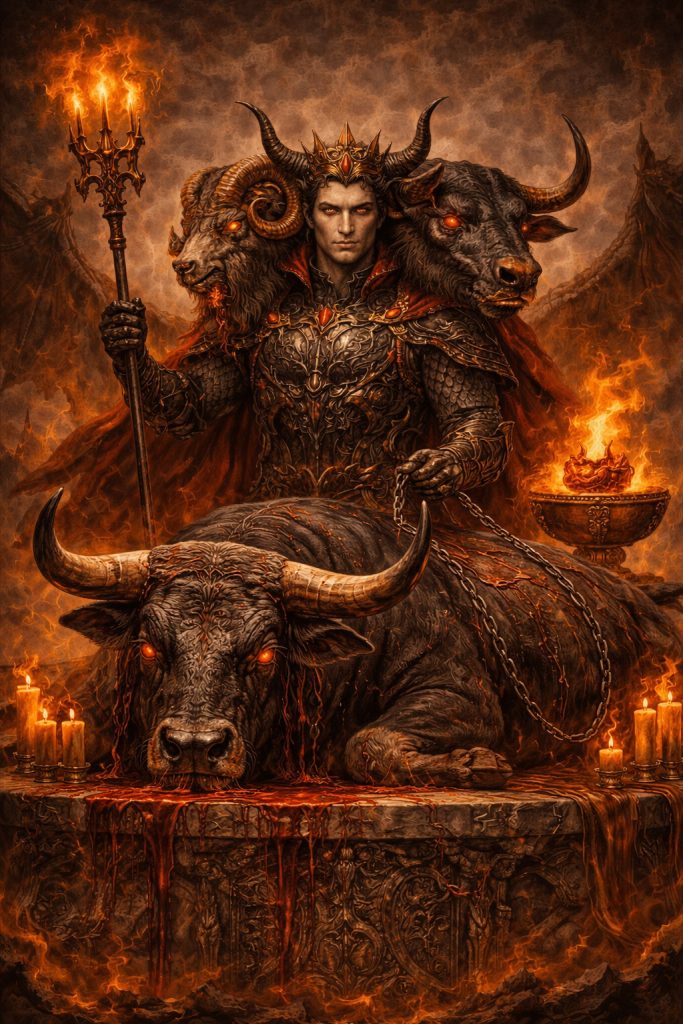
Thus the Cold-Hearted King achieves his design: as mechanical substitutes proliferate, genuine participation wanes, transforming others into mere functions. Modern people, oblivious of one another, interact only with avatars and screen images, neglecting the vitality and reality behind them. This is modern greed: the hunger to be “informed” replaces the drive to be strong, and amassing stimuli and data supersedes internal work.
The contemporary mechanization replaces the living with the manageable. Acting “on autopilot,” one seeks to render others, relationships, and life itself predictable: people become evaluable functions — convenient or inconvenient, useful or useless; relationships turn into service — “to ensure proper functioning”; conversation becomes signal exchange — speak, receive a reaction, move on. Life thus becomes a checklist — seize, squeeze, optimize. This facilitates possession, as the living and free resist ownership: they change, argue, require engagement, may depart. Turn the living into a scheme, a mechanism, and it becomes easier to control. Instead of contact, the Bull of Asmodeus proposes continual assessments — where does this interaction lead, what can be gained, how best to respond; instead of trust, conditions and rules replace vanishing internal bonds; instead of true strength, accumulation prevails — techniques, explanations, validations creating a sense of control but not deepening consciousness; instead of paths to logos, there is endless optimization, turning rest, love, inspiration into “projects” to be improved and preserved. The mechanical person, regarding themselves and others as machines — on, off, adjustable — reveals not rationality but fear, greed: a desire for guarantees, avoiding risk, eschewing responsibility in choice.
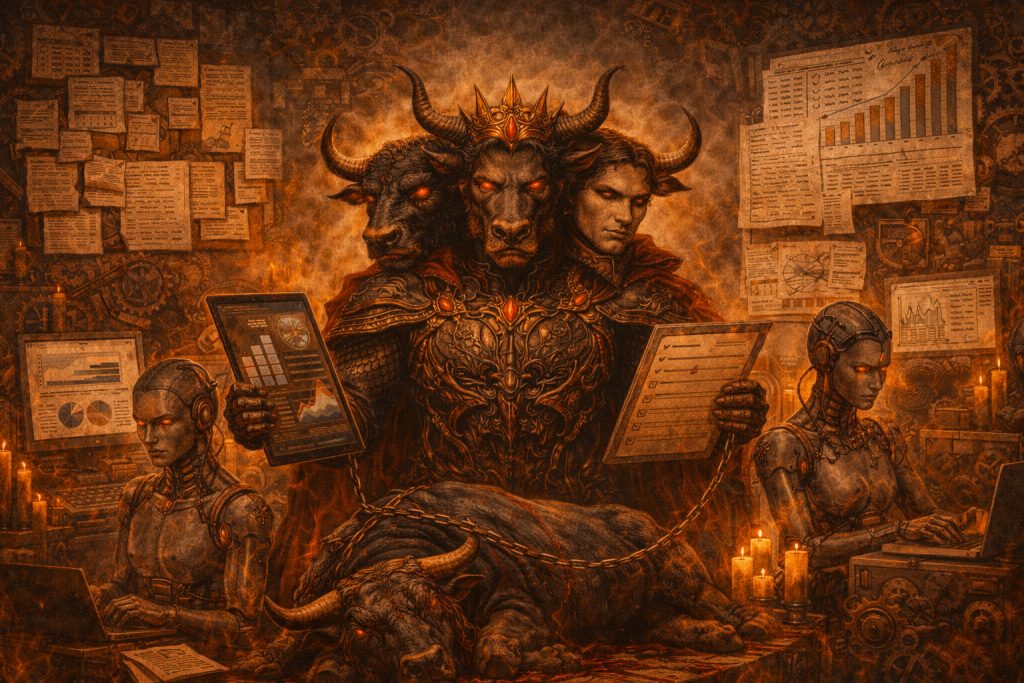
As the ram — crude passion — is sacrificed for clarity and freedom, today demands the sacrifice of the Bull, surrendering the belief that external reinforcement can replace strength, and external stimuli supersede internal fire. Beyond this, it requires sacrificing Asmodeus’ human face: the abdication of the right to possess, to justify appropriation, to make another a pawn of manipulation.
To counter Asmodeus’ three faces, resistance must match his multi-faceted nature: the King closes hearts with three hands, necessitating triple awakening for liberation. Against the ram, transforming desire into entitlement, return the body to its primal attraction: relationships thrive when preserving otherness. Clarity in desire prevents turning it into grasping. Asmodeus thrives on substitution where passion masquerades as “love”; clarity demands distinguishing life and mutual intention from mere consumption and appropriation.
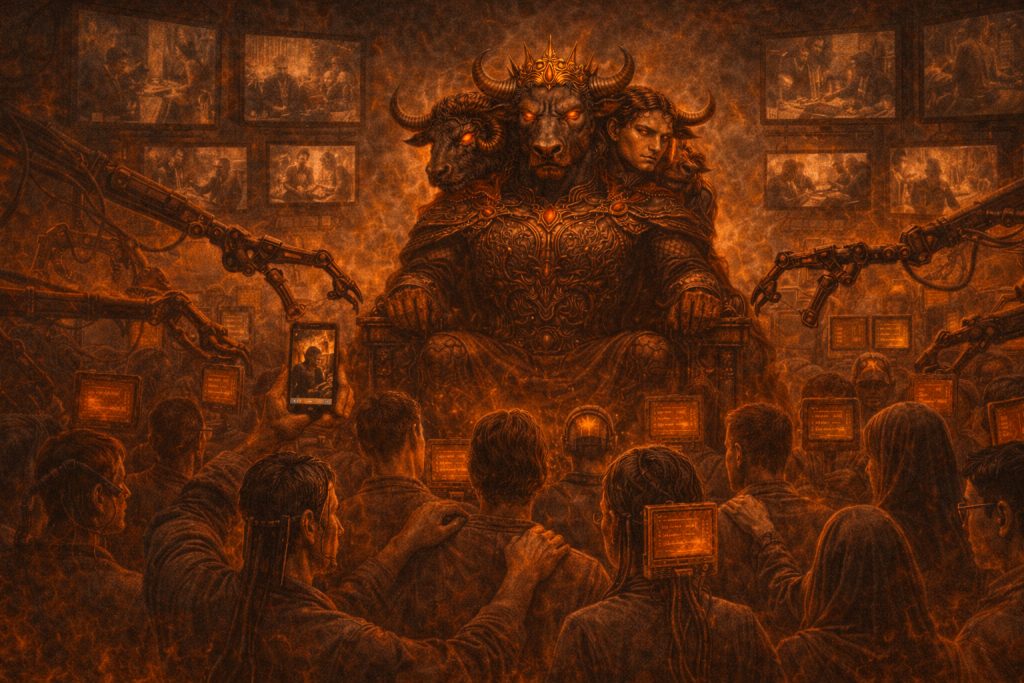
Against the bull face, promising strength through accumulation, align knowledge with action: knowledge is valuable when it informs practice, and practice is vital when it fosters consciousness development. Feelings require attention as thoughts do; recognizing cooling prevents confusing clarity with callousness and control with maturity.
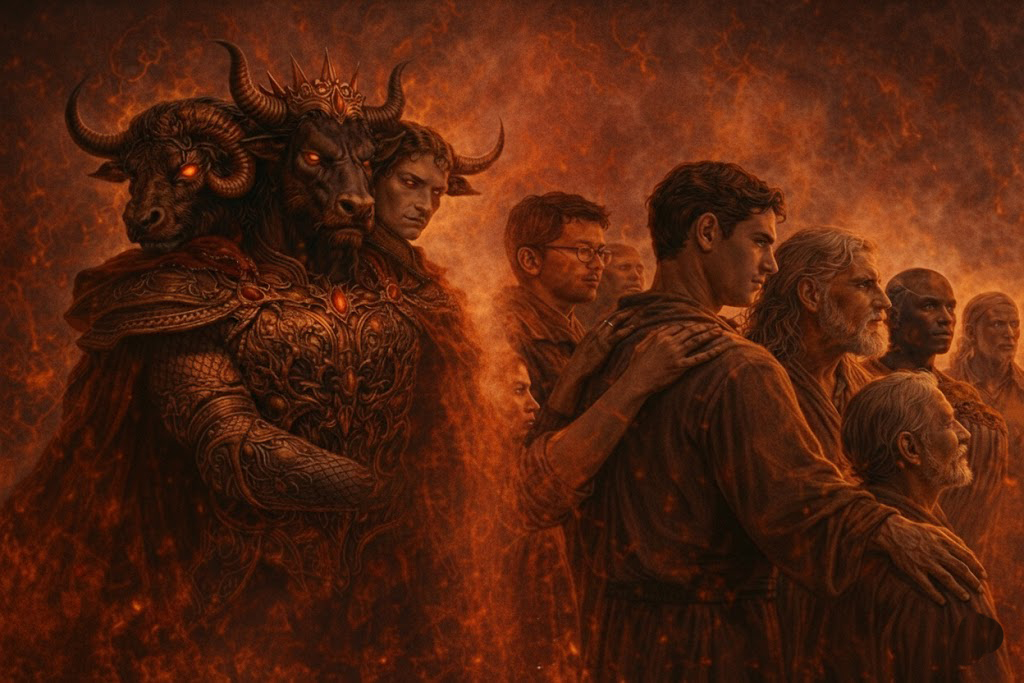
Against the human face, foster personalism: see the other as an autonomous center, not a function; let fidelity be free choice, not compulsion; let care be empathetic presence, not manipulation. Such clarity of loving mind expels the Cold-Hearted King.
The world, under Asmodeus’ influence, denies freedom and spontaneity, reducing people to “gadgets” ripe for manipulation without qualms. It echoes the tale of Asmodeus usurping Solomon’s throne, replacing wisdom with manipulation. Therefore, the ideal of freedom is profoundly relevant: in a world oblivious to its reality, relearning to acknowledge others’ reality is crucial. Failing to do so leaves humanity as subjects and objects of possession, mere resources for use and disposal.
Some of “them” prefer to work individually with people, specifically with black “mages.” One such mage is Ass, and Beliar practices it too. Such a “mage” becomes a gateway for the demon’s influence here, consciously carrying out its will and following its direct orders, fully aware of what they are doing. In return, the demon teaches them and somehow “helps” them. Refusing to obey orders results in punishment after the first harsh warning — death. After such “collaboration,” when the “mage” finishes their life here, if they don’t end up in the lower hells burdened by karma, the demon often “re-codes” them and waits for their next reincarnation. When the “mage” is ready, the demon “comes back” to them, often starting in dreams, and the “service” continues. That’s how it works. However, if in the next life no “contract” is made, there’s a possibility to refuse the “service” and renounce the demon. In this case, the demon “has no right” and won’t be able to punish for the refusal. But it goes without saying that it’s difficult to do when you’ve become almost like it, and its coding resonates in your blood and mind…
just a small correction. I made a mistake with the names. Beelzebub prefers “individual” work. But the likes of Astaroth and Belial ignore individual people.
Hello. Thanks for the article. I have a question.
How can I interact with a girl normally?
I have fears of betrayal and worries that she might reject or leave me, and so on.
At the same time, I understand that trying to control someone is exhausting, stressful, and unpleasant. Plus, it takes away from the pleasure of the interaction. And yes, during our time together, I keep thinking about how to influence her.
I don’t like this, I get tired of it, and these worries will probably only worsen our relationship, health, and happiness in the future.
What attitude should I have towards the girl I have feelings for?
The future is scary, and her past worries me. But I have no intention of giving her up.
Thank you so much for such depth!