
The Spear — Sacred Symbol of Authority
The symbol of the Spear as a sign of Supreme Authority has been known to humanity since ancient times.
The Spear had solar and cosmological meaning and was associated with the World Axis. Moreover, it was perceived as a phallic symbol. In this sense, the Spear also signifies the masculine principle, the life-giving force, fertility, martial valor, and the Magus’ wand. The phallic meaning of the Spear can be illustrated by the Vedic cosmogonic myth of churning the ocean of milk with a spear or by the Orphic tale of the world egg smashed by a spear.
The Spear is an indispensable weapon of warriors and hunters, enabling them to strike prey at a distance. A spear hurled at a target personifies the achievement of a goal and overcoming spatial boundaries. Thus, the Spear becomes a symbol of masculinity in all its aspects — expansiveness, vitality, and dominion.
Another important aspect of the Spear’s symbolism is its sacrificial meaning. The Spear, as a symbol of the generative power of the Great Father, is used for sacrifice — that is, of the deity and entry into matter. From this point of view, the myth of a god being struck by this spear is of particular interest.
The mythologies of different countries and peoples mention sacred spears.
The Ugaritic god of the Sky, thunder and fertility, Baal, is depicted with a lightning-spear striking the earth (an image of the erotic union of the two principles).
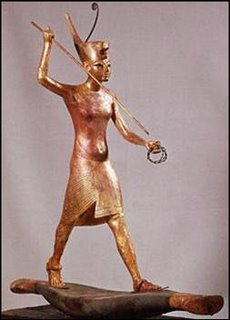
In ancient Egyptian mythology, there is the Spear of Horus, which was blessed by the goddess Neith. “Its barbs are rays of the sun, its points the claws of Mafdet” (the goddess of punishment).
According to Greek tradition, from the shaft of a spear, Zeus created mighty men in the Bronze Age. The Spear became the weapon of earthly aggression and war. The people of the Bronze Age loved battle and often waged war.
They all perished in bloody battles in the land of Thebes, in the land of Cadmus, fighting over Oedipus’s inheritance; others fell at Troy. But most of them ended up in the underworld, in the realm of shades, or settled at the edge of the earth, far from living men. This occurred at the end of the Bronze Age, when weapons began to be made of iron rather than copper.
In the ancient world, if a courier appeared with a wreath at the tip of his spear, it signified victory; bearing a bird’s feather, it was a sign of defeat and misfortune. Telephus, son of Heracles, was wounded by Achilles’ spear and was healed only by the touch of that same spear to his wound.
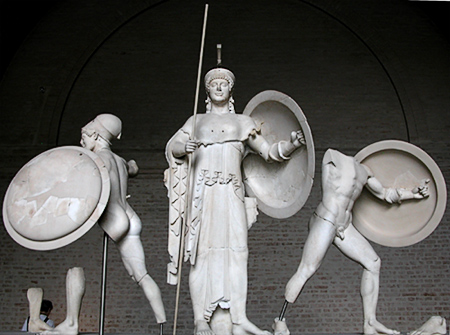
Greek mythology also has the magic spear of Procris, which Artemis gave her. This spear would hit its mark on its own and return to the thrower. By that very spear, which never missed, Procris’ husband accidentally killed her. Athena, in her contest with Poseidon over the possession of Attica, struck the ground with a spear, and an olive sprang up at that spot.
The positive meaning of the spear: if it is thrown skillfully, it flies far; if the spear is entwined with vines and serves as a support for the vine, then a land where spears support vineyards prospers.
Ovid mentions a marriage ritual in which the butt end of the shaft is drawn along the parting of the bride’s hair. Pindar recounts the legend of Ceneus, who demanded that the spear be revered. The spear whose shaft sprouted shoots is the story of Romulus’s spear, related by Ovid in the Metamorphoses. It put down roots on the Palatine Hill and symbolized the dependence of supreme power on divine will.
However, the greatest renown has been acquired by three spears of European mythology — Odin’s Spear (Gungnir), Lugga’s Spear (Assal), and Longinus’ Spear (the Spear of Destiny).
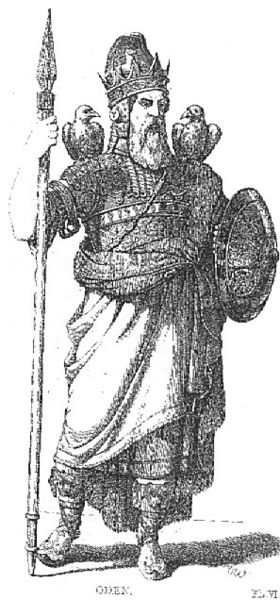
Odin’s Spear — Gungnir (Danish, Norse, Swedish: Gungner) — was forged by the two dwarf brothers Ivald (in some sources the primordial smith Dvalin is mentioned) to demonstrate the underground folk’s skill to the Aesir. It possessed the magical property of striking any target, piercing the thickest shields and armor and splintering the hardest swords, and after being thrown, it returned to its owner. It was the throw of Gungnir that announced the beginning of the First War — the war between the Aesir and the Vanir.
Gungnir can burn the hand of someone to whom it does not belong. At the same time, it was with Gungnir that Odin nailed himself to the world ash and remained between life and death for nine days, after which he acquired the knowledge of the Mysteries of the Runes.
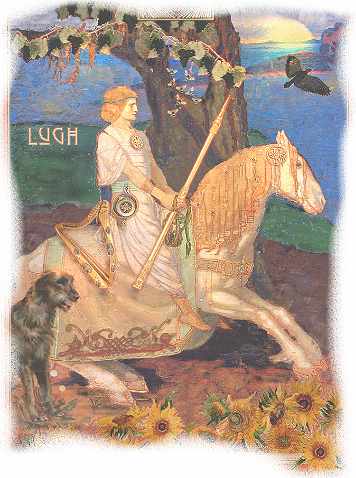
One of the magical items of the tribes of the goddess Danu was Lugga’s Spear, which always granted victory to its possessor.

Lugga’s Spear was brought from the city of Gorias, one of the ancestral cities of the Tuatha Dé Danann. This spear (also called the spear Assal), according to tradition, was won for Lugh by the so-called three gods of craftsmen. This spear had a solar and cosmological meaning and was associated with the World Axis. In Welsh legends, Lugg (known there as Lleu) was struck by a spear while standing with one foot on the rim of a cauldron and the other on the back of a goat; he fell victim to betrayal by his wife, Blodwedd. Pierced by the spear, he turned into an eagle, which flew up and settled on an oak that was also the world tree.
The spear with which the Roman legionary Gaius Cassius delivered the “merciful blow” to the crucified Christ, together with the Shroud of Turin, is considered one of Christianity’s most important relics. It absorbed all the traits of the spear’s symbolism as a sign of supreme authority and was enriched with new ones.
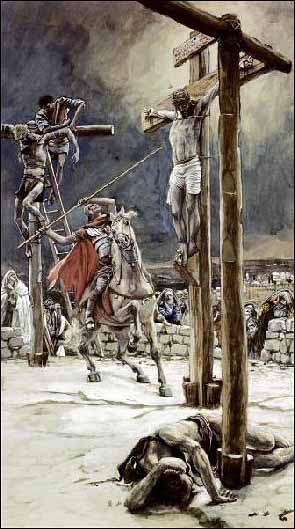
This spear, washed in holy blood, acquired, according to the faithful, extraordinary magical properties. Longinus’ Spear freed the Savior from torment, and for that reason became sacred. Today several relics in various churches and museums around the world are considered the Spear of Destiny. Three, however, are the most famous.
1. The Vatican Spear is kept in St. Peter’s Basilica in Rome, where it arrived in the 18th century from Paris, where it was believed to have been kept since the time of the Crusades. It is identified with the spear that had been kept in Constantinople, and before that in Jerusalem, at least since the fifth century.
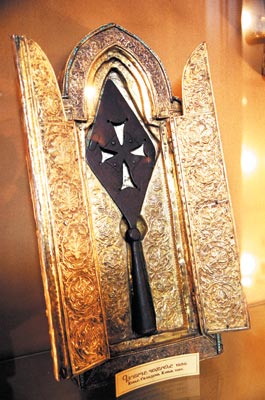
2. The Armenian Spear is kept in the treasury of Echmiadzin, where it has been since the thirteenth century. Before that, it was kept at Geghardavank, where, according to tradition, it was brought by the Apostle Thaddeus. Geghardavank literally means the Monastery of the Spear.
3. The Vienna Spear traces its history back to the time of Otto I (912–973). It is characterized by an inlay of metal that is believed to be a nail from the crucifixion. After the Anschluss of Austria, Adolf Hitler moved the spear to Germany and placed it in Nuremberg. It is said to have been returned to Austria by U.S. General George Patton and is presently kept in the Imperial Treasury. But no one can say this with certainty.
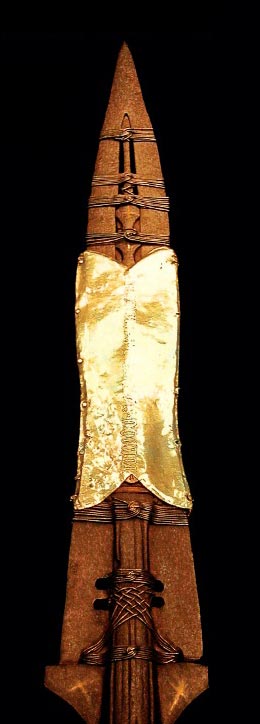
An ancient prophecy states: “He who possesses this Spear and knows which powers it serves holds the fate of the world in his hands — for good or for ill.” The Spear of Destiny endowed its owner with the ability to establish good, win victories, and perform superhuman deeds.
They say this Spear was forged for his secret purposes by the third Jewish high priest, son of the high priest Eleazar and grandson of Aaron — the magician and kabbalist Phinehas. A vigorous public figure, and, when necessary, a military commander who did not shrink from executing apostates with his own hand, Phinehas repeatedly communed with a power then called a god, and proclaimed its will to his people. The Spear throughout his life aided him in achieving ends inaccessible to ordinary mortals. Over the years, the fame of the mighty relic only grew, and so did the number of claimants. It was held in the hands of Joshua as he looked upon the collapsing walls of Jericho. King Saul hurled the magic talisman at the young David. Herod the Great, leaning on the Spear, gave the order to slaughter the innocent infants. Then, by providence, it came into the hands of the Roman centurion Gaius Cassius, and the dead Christ obtained eternal life.
A soldier by birth, compelled to serve as a scout, inherited his spear. According to the Gospel of Nicodemus, his grandfather received the weapon from Julius Caesar for bravery shown during the Gallic Wars. After Jesus’ death, according to one account, Gaius Cassius asked for his discharge, joined the followers of Christ, and ended his days as a hermit in the ancient city of Mazaca in Cappadocia — the modern Turkish city of Kayseri (a corrupted form of the name “Caesarea”).
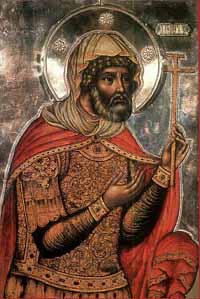
Later the spear came into the possession of Joseph of Arimathea, who, together with the cup of Christ’s blood (the Holy Grail), carried the Holy Spear to Britain, passing it on to a legendary figure remembered in history as the “Fisher King.” He also became the keeper of the Holy Grail. Possession of the spear played a cruel trick on the Fisher King — he became a eunuch.
Legends say that the Spear was also in the hands of the Roman Caesars Diocletian and Constantine (3rd–4th centuries); of energetic Visigothic kings, the destroyers of the Roman Empire, such as Odoacer (5th century); the long-haired Merovingians, among whom stands out the baptizer of France (496), the cruel and indiscriminate Clovis, grandson of that Merovech; as well as the last active leader of that dynasty, nicknamed for his prudence and prescience the Solomon of the Franks, Dagobert I (629–639); Pippin of Herstal (second half of the 7th century), nicknamed the Battle Hammer, the great-grandfather of the famous Charlemagne — the legendary unifier of Europe — Charlemagne for the French and Karl the Great for the Germans (742–814).
According to legend, the leader of the Huns, Attila, called the “Scourge of God” (c. 406–453), approached the gates of Rome, but Pope Leo I managed to ransom the fearsome foe. Before leaving the besieged city, Attila is said to have ridden up to a group of Roman warriors and thrown a pike at their feet. Dismounting from his horse, the Hunnic leader allegedly cried out: “Take your sacred spear — it is no help to me, for I do not know the One who consecrated it.”
Charlemagne may very well have seen and even held the authentic Spear. In 799 and 800, the Patriarch of Jerusalem, wishing to initiate a crusade, sent envoys to him with blessings and sacred relics, among which were, it is said, the keys to the Holy Sepulchre and the keys of Jerusalem itself. Charlemagne did not yield to persuasion and contented himself with expensive gifts and large monetary donations. The monks of Mount Zion made one last attempt in 803. Two men arrived in Salzburg on a secret mission to Charlemagne. There is a version that in the course of their entreaties, as a final argument, they demonstrated to him the power of the Holy Spear. Charlemagne won forty-seven battles, in each of which, according to legend, he took the spear. When the emperor was returning from Saxony, a comet streaked across the sky, his horse bolted in fright and threw its rider. The spear Charlemagne held in his left hand fell into the mud. Soon the king died.
The documentary history of the Spear of Destiny begins on 14 June 1098 in Antioch. It was recounted in detail by an eyewitness to those events, the chronicler and canon Raymond d’Aguilers. According to his chronicle, Saint Andrew appeared several times to a Provençal peasant, Peter Bartholomew, and showed him the place where the Spear of Destiny had been buried. He also demanded that it be reported to the valiant knight Raymond, Count of Toulouse.
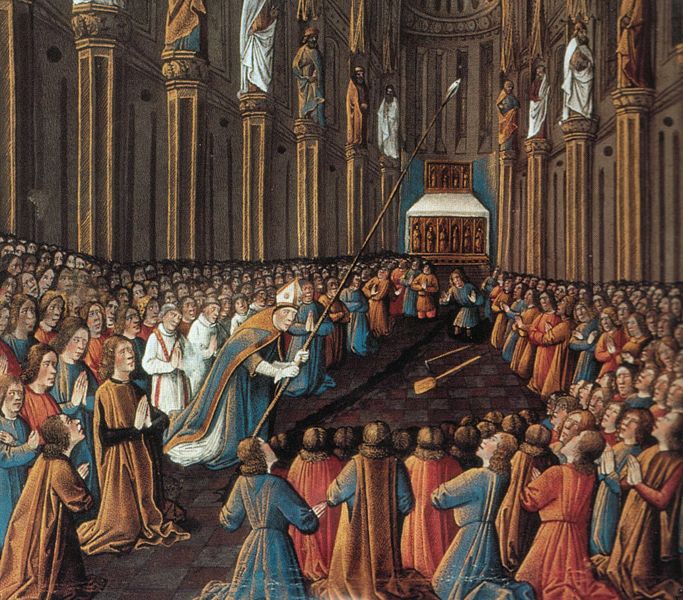
Having finally overcome every obstacle and fulfilled numerous conditions, a group of knights, after prayer, began excavations in the Cathedral of Saint Peter. And everything happened as had been foretold. The found Spear did not delay in demonstrating its miraculous power to the unbelieving: enemy fortresses began to surrender one by one to the crusaders, who had recently been suffering defeats. With divine help, Jerusalem soon fell as well.
To Europe, to Paris, Longinus’ Spear was brought from the Holy Land by Louis the Saint (1214–1270). From that moment, nearly every known emperor possessed it.
One British historian, in a monograph on King Charles IV of Bohemia, relates that his retinue discovered the tip of the spear that pierced the Savior’s side in a Cistercian monastery in the Tyrolean mountains. Unfortunately, this gentleman did not explain how the spear had come to rest within the monastery walls.
It was Charles IV who first called the find “the Lord’s Spear.” He ordered the tarnished silver to be gilded and the old inscription replaced with the more accurate “The Spear and Nail of Christ.” The relic was put on public display in Prague Castle. Emperor Sigismund of Luxembourg (1368–1437), under whose rule the Czech reformer Jan Hus was executed, moved the spear from Prague to Nuremberg. The transfer of the treasures was carried out in a rather original manner — they were hidden under a pile of fish loaded onto a simple cart escorted by four men. Along with the spear, there were the tooth of John the Baptist, the relics of Saint Anne, and a fragment of the wooden manger in which, according to tradition, Mary laid the infant Christ.
To prevent the relic from falling into Napoleon’s hands, the city council of Nuremberg decided to hide the imperial treasures temporarily in Vienna. The mission was entrusted to Baron von Hugel of Regensburg, who, after the dissolution of the Holy Roman Empire in 1806, sold the imperial treasures to the Austrian imperial house of the Habsburgs.
Napoleon, victorious at Austerlitz, immediately demanded the famed talisman be brought to him. He kept it with him until he marched on Russia. Meanwhile, the Spear was stolen, which, so the story goes, contributed to his defeat.
Hitler was well acquainted with the legend of the Spear and saw it several times in a Viennese museum. It so impressed him that he resolved even then to possess it and rule the world with its aid. Immediately after the annexation of Austria, the Spear was entered on the list of the “Fuhrer’s personal relics” and transported to the Reich. Heinrich Himmler longed to possess the relic which, according to legend, endowed its owner with magical powers, but he had to be content with a replica, made at his order already in 1935 and placed in Wewelsburg Castle.
Having seized the Holy Spear, the Nazis kept it very carefully in Nuremberg alongside other treasures, constructing a special building with an elaborate alarm system. There is a theory according to which, after the defeat, the cream of the German nation, together with all the sacred relics (including the Spear of Authority), escaped on several submarines to Antarctica, where an underground city had been prepared in advance in the region of Queen Maud Land. And all the flying saucers that began to appear only after 1947 are nothing but the work of people living there, possessing technologies unknown to us.
As a result of a skillfully conducted operation (the Germans attempted to transport the Spear and two other sacred items just before the fall of Nuremberg, but through a very strange turn of events they, by mistake, suddenly confused the “spear of St. Maurice” with the “sword of St. Maurice”), the American Seventh Army under General Patch seized both the city and the treasures. Learning of Longinus’ Spear, the most legendary and most eccentric U.S. general — Patton — hurried there at once. Believing in reincarnation and magic, and for several years occupied with the search for the Holy Grail, he understood very well what he held in his hands, for he told the officers accompanying him that difficult times were coming for humanity.
And again the history of the spear is lost in the mists of time — it is still unknown where that very Spear of Authority now lies.
Thus, even today, the symbolism of the Spear as the emblem of supreme priestly authority has not lost its original meaning.
Is it possible to relate the spear of power to the force of awareness?
“Rather, with the power of the mind.”